

Quick-fire Roundup - June 2026
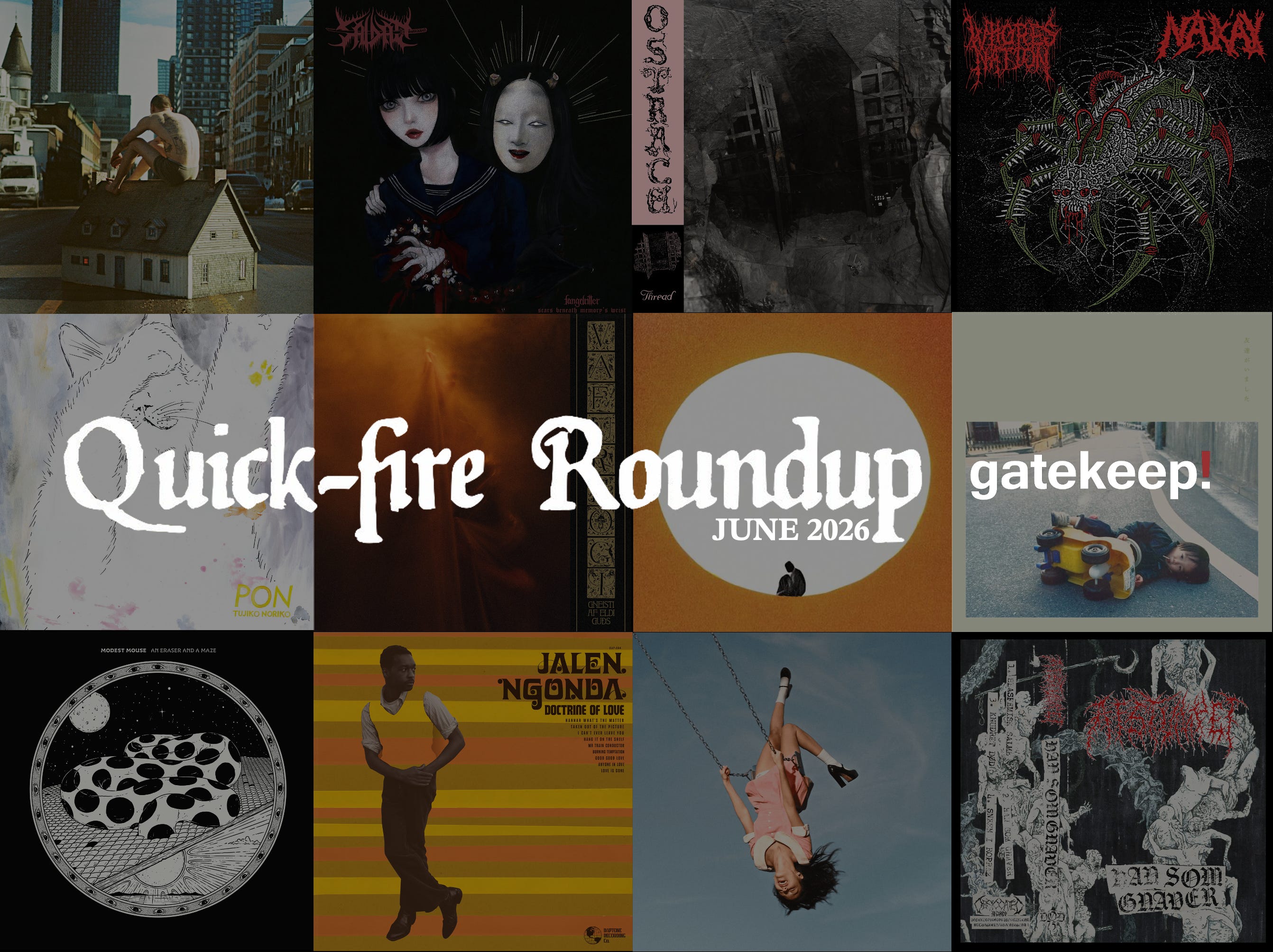
Short reviews for some of our favorite releases of the past month.


Quick-fire Roundup is our chance to highlight a few of the albums we’ve been digging from the past month that we may not have had the time or energy to pump out full essays for.
Death Cab for Cutie – I Built You a Tower
38:34 // June 5th, 2026 // ANTI-
Fresh off anniversary tours for their breakthrough records Transatlanticism and Plans (as well as Give Up, a one-off by front man Ben Gibbard’s side project The Postal Service), Death Cab for Cutie re-entered the studio with old memories on their minds, aiming to recapture the vivacity of their youth while molding that energy to less naïve ends. Circumstance gave them the perfect chance: writing in tandem with his second divorce, Gibbard resolved to not resort to finger-pointing or spur-of-the-moment disdain, opting instead to take stock of the fallout and wax about the push-and-pull of romantic separation and the personal factors that drive parties to construct emotional walls.
It’s a wiser record for it and doesn’t arrive at easy answers, but each sentiment nonetheless lands like a revelation—“Full of Stars,” “Pep Talk,” and “Trap Door” are all restrained, gorgeous masterstrokes of songwriting worth their economical construction, while Punching the Flowers” and “How Heavenly a State,” intertwine the more unsettled, embittered indie rock the band once considered home. Intermittent familiarity with their catalogue discouraged me from rambling on and on in a longer review, but on its own merit, I Built You a Tower is one of 2026’s finest lyrical statements, and it’s well worth the repeated spins to let each understated cut sink in. (8.5/10)
- Zack Lorenzen
Modest Mouse – An Eraser and a Maze
48:54 // June 5th, 2026 // Glacial Pace
I wouldn’t blame anyone for being skeptical about Modest Mouse’s stock in 2026: though their early days yielded a run of inimitable indie rock classics, lineup changes in the mid-aughts catalyzed the dilution of their signature sound, and with it, any semblance of quality control. 2007’s We Were Dead Before the Ship Even Sank and 2015’s Strangers to Ourselves respectively nuzzled into a sweet, if unadventurous spot and threw everything at the canvas to see what stuck. By the time 2021’s The Golden Casket dropped, they’d not only ceased to write music worth returning to, they’d seemingly lost any incentive to care.
At the tail end of 2022, the sudden illness and death of founding drummer Jeremiah Green evidently prompted front man Isaac Brock to cut the bullshit. An Eraser and a Maze is directly inspired in large part by Green’s death, full of candid, diaristic disclosures to a departed friend, and even in its non-eulogistic margins, mortality looms heavy over the material. In turn, it’s a dour, meditative affair—“Life’s a Dream” and “Third Side of the Moon,” for example, languidly mourn, while “Remember Yourself Not Me,” and “Speak ‘N Spell (Or Not)” bristle with something closer to joy, in awe of the great cosmic improbability of being alive. If, in our grief, the lost get to live on inside us, Brock accepts that task nobly and with little feet-dragging. A few unnecessary, inconsequential interludes don’t detract from the fact that this is Modest Mouse’s most important, artistically reassuring, and vulnerable material in a long, long time. May we not take it for granted. (7.5/10)
- Zack Lorenzen
Tujiko Noriko - Pon
70:23 // June 12th, 2026 // Editions Mego
The direction that Tujiko Noriko took with this album was a pleasant surprise given her trajectory over her quarter-century career; she’s getting back in touch with the eclectic glitch pop of Make Me Hard while leveraging her more recent experience with ambient. This combination of approaches has yielded something that feels new, strange, and challenging, even for someone intimately familiar with Noriko’s discography. I found my footing thanks to Pon’s desolate, mourning tone, which, with some attention and time, comes through even in its most experimental moments. The loss that Noriko is working through here (see our delightful interview with her for more on this album’s context) was clearly profound. After many listens, I feel a connection to the feelings she’s expressing that’s as specific as it is intense; the album conveys its theme with near-filmic clarity, even through the language barrier. Tracks that were unimpactful on early listens now strike me as essential parts of the whole, like that meditative series of establishing shots or everyday, low-stakes character moment that makes a movie’s emotional core resonate more completely and stick with you long afterwards. It’s beauty, in other words, of that precious, personal sort that only the best art can be.
I’m writing this a few weeks and maybe a half dozen listens after finishing a longer review, which I’m already acutely dissatisfied with. Many of Tujiko Noriko’s albums have been growers for me, but I’ve still been caught off guard by how much more impactful Pon has gotten over my time with it; it’s been flat-out making me cry, recently, at different moments with each listen. The rating below is probably not long for this world—don’t be surprised if by the end of the year it’s among my all-time favorites. So be patient with it, if you can. Try it when you’re feeling wistful and porous. Revisit it after some time away. Let Noriko into your life for a while, and miss her cat together. (8.5/10)
-Caleb Yarbrough
Saidan - FANGDRILLER: Scars Beneath Memory’s Wrist
47:13 // June 19th, 2026 // Avantgarde Music
The fact is black metal used to be a genre that would shock and upset conservative parents and Christians. Now the only people you can actually shock and upset are the die-hard black metal fans themselves because they’ve become soft.
Even by black metal’s po-faced carnival standards, Saidan are a silly band. Enjoyable as it is to see anyone taking potshots at genre purists, frontman Splatterpvnk [sic]’s ragebait antics are right on the line of scrappy contrarianism, and as far as the Brand is concerned, I’ve never taken his J-horror necrophiliac schtick seriously enough to be offended by it (a good thing too judging by this album’s lyrics and the ambiguity of where the protagonist of the album’s concept got her name from [1]). As with many a band to flog edgy branding out of a morbid concept – Children of Bodom immediately spring to mind – it helps somewhat that Saidan roll with a happy-go-lucky attitude, and still more that their music is a ton of fun.
If the aesthetics portend an irreverent smattering of cheap thrills, then you’d better buckle up because that’s exactly what you’re getting: thrills, thrills, thrills, thrillingly thrilling and so dispensably plural that cheapness is a vital prerequisite for their ease of consumption. This is not criticism: Splatterpvnk has a razor-keen understanding of the mileage at which riffs-per-minute music is best enjoyed, and there’s arguably less joy to be had in pondering the distinctions of individual songs than there is in savouring the relish with which he and powerhouse drummer Hundosai deliver one incensed banger after another.
As per usual, the band take kitsch in their stride. The lofi edge they rode like a chill wind on 2022’s stellar Onryō II may have been filtered out for a more temperate airspace – that’s nu-criticspeak for copious reverb and a shitton of cinematic goth synths, keep up – but it’s churlish to demand edgier aesthetics when they get such mileage out of going full Disney (”Her Lips Pressed Against a Coffin Nail”). Elsewhere, “Kara No Bara” and “Beat to Death” are at least the equal of the meticulous songwriting refinement for which we frittered so many words over Deafheaven last year. Suddenly Saidan’s edginess seems a whole lot more welcome. Don’t call me. (7.5/10)
[1] I was unaware of this link until I read up on Saidan’s album for this blurb, and am a lot more reluctant to handwave it away as inconsequential kitsch compared to the rest of the band’s themes and imagery. For those unfamiliar, the Junko Furuta case is one of the most vile degradations of human life to occur in modern criminal history, and it’s so embedded in the mythos of J-horror that it’s implausible for Splatterpvnk to have chosen the name Junko for his protagonist without awareness of the connotations (given the sexualised gamut of isolation, captivity, mutilation and burial he puts her through).
It inspires absolutely no joy to see a historical tragedy exploited once again for gauche edginess, but from what I can tell, the Junko-character in Saidan’s lyrics is more a vehicle for fiction than an attempt to directly recycle the history. Ick-worthy? Absolutely, but I’m more prepared to view Saidan within the scope of artistic licence than, say, the way Sewerslvt directly co-opted that identity as part of her own persona. Perhaps I’m overextending my good faith out of consideration that, unlike Sewerslvt, Saidan make good music and have yet to reduce their entire sub-genre to vacuous e-bilge. Chalk the Junko reference up as a similar level of cringy postulation to Trent Reznor recording his seethe opus on a Manson killing site and leave those morbid fantasies at arm’s length, or else get your pitchfork out and decry the irony of those being loudest to call out black metal purism being the most degenerate horror freaks of all. Either way, more fool Saidan for thinking their sickly overtures to the cult of dead schoolgirls would make this album riff any harder.
-Hugh Puddle
Trooper Salute - 友達がいました [Tomodachi ga imashita]
55:16 // June 17th, 2026 // Buriki Records
Finally, as has long been foretold: the second coming! (of advantage Lucy!)
This is a very promising and impressively ambitious debut. Trooper Salute have emptied their whole fridge into this thing, and while some of the ideas aren’t perfectly ripe the full experience is perfect comfort food. I’m tempted to call it uneven, but that feels like the wrong word; I think some of the tracks are notably worse than others, or at least I have problems with them, but my enjoyment and investment while listening is near-seamless. Every moment is delivered with such heartfelt conviction and youthful energy that I can’t help but enjoy myself, even when they’re strung together ungracefully or thrown in ill-advisedly. That said, some of these tracks are unmitigated triumphs: ホーリーナイト [track 5] captures most of the sound and style of this album, showcasing well-crafted hooks in the first half and shooting for the moon in the second. 悪知恵 [track 9] is an immaculate dream pop detour with one of the easiest-on-the-ears vocal melodies I’ve heard in a minute. 友達がいました [track 11] manages to last a full 8 minutes of arena-oriented post-rock without putting a foot wrong, with keyboardist Komiya’s lead vocal performance fully vindicating the choice to share those duties with main vocalist Musashi. If you’re a fan of Station/Oolt Cloud-era advantage Lucy, or Kinoko Teikoku’s debut, or similarly passionate, maximalist rock (I’m even reminded of Ants From Up There at times), you will not want to skip this. (8.0/10)
-Caleb Yarbrough
Vafurlogi - Gneisti af eldi Guðs
48:51 // June 19th, 2026 // Norma Evangelium Diaboli
Following up their already impressive debut, Vafurlogi continue to deliver high-quality black metal in the same lineage of the post-DSO melody-forward work of Mgla, here with a pleasing dissonant edge that calls to mind fellow Icelanders Svartidaudi. I experience this album primarily as a very well-packaged series of emotionally resonant lead guitar melodies; if you prefer your black metal to lean more into infernal aesthetics, dramatic camp, or fast-paced fun, this probably won’t be a highlight of the year for you. It’s my favorite standard black metal of 2026 so far, third favorite of extreme metal more generally (well behind Miserere Luminis, a bit behind Kaatayra). My only complaint (and it’s quite minor) is that there aren’t a lot of especially standout, memorable moments. The songs all feel distinct and are consistently well-written and executed, but it’s much more a great album experience than a collection of individual bangers. That said, my favorite track is the closer. It doesn’t waste a minute of its longer runtime, and I’m a sucker for the lonely grand piano taking over the lead melody for the final 90 seconds. (8.0/10)
-Caleb Yarbrough
Ostraca – Thread
35:42 // June 26th, 2026 // Persistent Vision
Richmond, VA’s Ostraca have spent over a decade playing shrieky, dim, cathartic screamo the old fashioned way, and they’ve done it so well that every new release of theirs feels like a trusty, reliable pick-me-up of put-me-downs. Without a dud in their repertoire, I imagined Thread would be more of the same, and it is, but like, more; there’s more space for their post-rock buildups to accumulate weight, more soil for their subterranean misery to excavate, more esteem for these expectations to supersede. Thread uses all of it and then some. If you’re into emoviolence or crust or any grim, volatile music of this nature and you haven’t gotten around to checking out Ostraca yet, this is an exemplary display of their craft. Tumble on into the cavern. (8.0/10)
- Zack Lorenzen
Afstumpet - Han som gnaver
13:23 // June 6th, 2026 // self-released / Dessicated
Between the new Lithopædia and Thætas records (both excellent!), June was the month of the Æ. And where is that Latin-Siamese marriage of letters most commonly used today? If you answered International Phonetic Alphabet, you would be correct, but I was trying to hint at Denmark, you wiseacre! Between needless verbosity and flagrantly insulting the reader, July is the month of rude trainwreck intros. In my defense, Han som gnaver doesn’t lend itself to a rhapsodic multi-paragraph write-up, what with its extensively plumbed stylistic heritage and its rapid exit.
As a general rule of thumb, when a release has an edition of fifty copies, you know you’re in for a good time. On their latest, Afstumpet join the ranks of broadly old-school, Incantation-based Copenhagen acts such as Phrenelith, Undergang, or Hyperdontia, offering a not exactly fresh yet vigorous hulk of raspy OSDM riffage driven by what I’d describe as a deathgrindesque mindset. What elevates the material – apart from the songs’ hook-like motifs that serve as mnemonic anchor points – is the modern spirit evident in the tessellation of genres: when they’re not ruthlessly blasting away, K and N weave in set pieces from the realms of death doom, sludge, disso, and even some rudiments of post. A good chunk of the writing is groove-centric in the non-cheesiest of ways and, despite the glaring differences, reminded me of works like Iniquitous or Funereal’s The Misery Season. Some of it is a tad too patched-up, and getting from point Æ to point Å can feel overly convoluted, but even in the face of their occasionally visible sutures, I appreciated the thoughtful little diversions sprucing up the tried-and-true substruction. Ultimately, its short runtime worked tremendously in the EP’s favor (+0.5) and made returning to it scarcely an imposition, as thirteen minutes are easy to spare even on a busy day. If the Danes can work out a way to string their ideas together in a more intuitive fashion, the hopefully upcoming full-length will be something to look forward to indeed. (7.0/10)
- Nex
Truck Violence - The Weathervane Is My Body
31:51 // June 26th, 2026 // The Flenser
I first listened to Truck Violence’s debut, the half self-titled Violence, after I’d heard The Weathervane Is My Body a number of times. I don’t recommend this; TWIMB is a step up from Violence in almost every way. Gone are the folky sections that stick out like a sore thumb (excepting “House caught fire”, which has the advantage of being both fantastic and a perfect match for the album’s tone): instead, the folk elements are integrated tightly with the rest of the noise rock soundscape, adding textural/emotional depth and structural dynamics to tracks that might otherwise be one-note (e.g. the second half of “Your name, It’s walking”). Gone are the whiny vocal timbres and failed attempts at swagger: on TWIMB the vocalist has refined his style almost to the point of reinvention, with far more emotionally resonant cleans and thicker, more robust harshes. Gone, frankly, are the weak tracks: Violence has clear highs and lows, while TWIMB is uncannily consistent. The sludge metal influences are more pronounced here, contributing further to the development of a distinctive sound that will certainly appeal to fans of Chat Pile or Daughters but doesn’t imitate them. There’s still room for further improvement, especially to better appeal to me specifically, but I have high hopes for future Truck Violence releases given their considerable progress up to this point. (7.5/10)
-Caleb Yarbrough
Jalen Ngonda – Doctrine of Love
30:36 // June 5th, 2026 // Daptone
While a quick run to the dictionary clarified that it wouldn’t be inaccurate, it feels patronizing to call the music of Maryland-born, London-based crooner Jalen Ngonda a “pastiche” of 60s & 70s R&B. Reverent of it? Sure. Emblematic of all the same killer traits? It’s got charisma for days, if that’s all you need. In arrangement and appeal, critical platitudes about how imitation is the highest form of flattery ring hollow against a bundle of bops as airtight as Doctrine of Love.
Some credit ought to directly extend to producers Vince Chiarito and Michael Buckley—their intimate capture of each instrument feels aptly old-timey yet bursting with life—but Ngonda’s writing is wise, to-the-point, and irresistibly hooky on its own terms, too. Better yet, his androgynous voice—silky as Smokey Robinson’s on quieter cuts, roaring with the fire of James Brown’s on spicier ones—is ear candy in and of itself, less an attempt to mimic vintage soul than a full-bodied resurrection of it. I don’t know if a hypothetical Boomer Jalen Ngonda would’ve written Doctrine of Love if he’d operated in Motown’s peak era, but we don’t need to concern ourselves with how good it would’ve fared if he had—in the here and now, it dazzles through forces stronger than tribute or mere nostalgia. (8.0/10)
- Zack Lorenzen
Whoresnation / Nak’ay - Whoresnation / Nak’ay
17:18 // June 16th, 2026 // LIXIVIAT
You’ll know what kind of album you’re dealing with after listening to three seconds of this, so there’s zero need for me to go full Albert Mudrian on you here. It’s a straightforward affair that sees both bands shift their approach to varying degrees.
Whoresnation had become increasingly deathy with each full-length, so I was surprised to hear them go almost pure grind for their side of the split, with the end of “Tardigrada” and the Caluwian vocals constituting the last traces of what they’ve been known to dish out. While this reversion will mark an upgrade for some, I thought they had perfected the incorporation of traditional DM tropes (which sadly are pretermitted in contemporary deathgrind most of the time and thus, paradoxically, were what made them stand out) without straying too far from the core principles on Dearth, and, consequently, missed the spice those inflections could have added to the undoubtedly competent, but now fairly vanilla grind fare.
Even more tragically, Na’kay also opted for more basic song structures. Their retrogression is somewhat masked by their still relatively novel blackened leanings, but as a front-to-back listen, their side compares unfavorably to the keen and checkered writing they presented on Closed Doors / Open Veins. Just to be clear, this is very good grind in the grand scheme of things. It’s just that it fails to underline the bands’ strengths. If you’re looking for something sitting between Fake Dust’s raving technicality and the polished, PV-fueled assault of Eastwood’s new LP, this is well worth checking. (7.0/10)
- Nex
Olivia Rodrigo – you seem pretty sad for a girl so in love
50:55 // June 12th, 2026 // Geffen
All records in the Top Ten (especially those that get to Number One) have far more in common with each other than with whatever genre they have developed from or sprung out of.
The KLF - The Manual (1988)
I was rooting for Olivia Rodrigo— really, I promise. Sure, Guts was clumsy and trite almost as often as it was plucky and convincing, but whenever “Vampire” started to really grate on me, I imagined some poor gawky tween with no one in her life cool enough to get her into indie rock being inspired to learn a power chord or four from seeing O-Rod toting around a Stratocaster, and my heart would soften. When I eventually wrote a fairly ambivalent review of Guts, I concluded that those tweens might deserve to be inspired by a more interesting songwriter. But I promise, pinky promise, I also heard real inspiration! At the very least, I heard energy, which was arguably more important for her purposes.
On Rodrigo’s new album, you seem pretty sad for a girl so in love, she skirts the question of whether her basicness was or is a mere artifact of youth by intentionally leaning into it. It’s artifacts all the way down on this one! Same as on GUTS (and Sour to a lesser extent), the backbone of the Olivia Rodrigo experience is her attentive handling of forty-odd years’ worth of alt-rock radio canon. She shifts from bubbly new wave to riot grrrl shout-alongs to glossy balladry to, why not, a flash of indietronica, all so frictionlessly that they barely even scan as different genres. Her heart may belong to the ‘90s (and, regrettably, still, to Taylor Swift), but she knows and loves the ‘80s, and if she hasn’t quite reached the ‘70s, she still wants us to know that they’re on her radar:
I like your big sister
Shе has your same face
And I tried to win hеr
Over with my cynical humor and yacht rock music taste
If that scans as a whole lot of telling and very little showing, then yes: that’s the form across the board here. Her taste has steadily matured over the past five years, but her songwriting still follows the motions of rigid formalism. She’s earnest in these – caught in “expectations”’ burst of above-it-all confidence, her power chords and tight rock grooves are anything but disposable accessories – but she still sounds palpably adrift without them, not to mention a tad stilted when she aims for a flourish (see the half-hearted dissonance of “Drop Dead”’s chromatic guitar fill).
Meanwhile, her lyrics demand that you take her propensity for spelling it all out as a personality trait: in a zeit geisted over by, say, Lana del Rey’s literary aspirations and Sabrina Carpenter’s unquenchable innuendo, the party line is to take O-Rod’s routine evisceration of subtext as a USP and leave it there (And here’s the part where the girl gets pissed / And the girl is me, did you get that hint?). She seems to wield normalcy as a defence against celebrity and to identify her artistry with the cipher she offers for universal experiences.
This is valid and probably admirable, but it doesn’t quite cover for the lack of personal distinctions she brings to the table. If she’s eked out a few more hard-won life lessons from her latest heartbreak this time around (lessons in using your partner as an all-purpose piece of void fillage on “the cure”, lessons in getting over it on “expectations”), it’s more than offset by the joylessly self-aware puppy love that eats up most of the A-side and curdles over the B-side. If that yacht-rock music taste can’t give her more tools for interesting songwriting than just hanging a lampshade on her trope, she’d probably do well to get into some music that isn’t quite so trope-deferential — or, better, make her own.
So are we Gatekeep!ing her? Maybe if she were in that awkward-amusing Harry Styles territory and the chief joy in following her was a tastemaking project crudely puppeteered by unseen impresarios, but her genre engagement is earnest (hi, Robert Smith!) and she’s brought some good to the culture (see the cross-generational magic of her all-female festival lineup). Does this make us more enthusiastic about pretending we’d still be talking about her tumblr-titled portfolio record if it weren’t for the statistics and discourse surrounding it? As with most things this proudly vanilla, it’s not that deep. Judge O-Rod by her platform, and she’s the right girl at the right time; judge her by her tunes, and, well, you’d think someone this concerted about carrying all the right torches would be more willing to start an occasional fire. (6.0/10)
-Kerry Renshaw and Hugh Puddle
Want even more? Check out our full-length reviews for these other June releases:


 | A guest post by
|