

INTERVIEW: Tujiko Noriko
One of the most singular voices in art pop goes in-depth on the tragedies behind her new album, her collaborations past and present, and how Kendrick Lamar became a family staple.

Long renowned for her ability to convey an intimate sense of personality through even the most abstract stylings, Tujiko Noriko is an experimental pop musician and filmmaker based in France. Her new album PON is a beautiful document of love and loss, named and produced as a tribute to her deaf cat, whom she rescued as a kitten and who recently passed away in an accident.
Noriko sets off today on a release tour of her native Japan, but she found the time to speak with us about the album and the grief-stricken context it emerged from, as well as the distinctions she makes between making ambient and writing songs, her new project CxBxT, her past collaborations with Aoki Takamasa, and her discovery of Kendrick Lamar and Charli XCX as family go-tos. It was a real pleasure to chat with her, and we’re excited to share her insight.

Hugh Puddle (GK!): So you were saying that you’ve got some vacation time at the moment?
Tujiko Noriko: No, actually, it’s... I just mean it’s like a vacation. I’m working but I have relatively a bit more time.
Hugh: Well, I hope you’ve been able to relax — but you released your new album PON last week! How did it feel to get it out? Are you happy with how people have been reacting to it, or have you switched off and just let it happen?
Noriko: As you know, you make an album, and then it takes time to be ready after making copies, so during this time, I tend to go forward for other things, and I don’t really look back. I didn’t have an account on Instagram, for instance – I was totally too lazy to do social media – but I asked my daughter to open it, like some months ago, in January or something, and I can see a small feedback, like, you know, like a personal message. That makes me think okay, yeah, there are people who are listening to it and appreciating the album, so I really appreciate that I’m not just blind about what I did, which happens to me sometimes.
I really appreciate that, especially as it’s dedicated to our cat, and then in the album there are sounds from my children and my friends’ children, you know, and they are all kind of related to this cat as well. So, yeah, it makes me feel quite... I don’t know, but then, even now, sometimes I’m emotional when I think of… Yeah, it’s kind of crazy. Like my friend was laughing at me, not mocking, but kind of laughing to make things look lighter, maybe, but it still makes me feel sad to think about the loss, it’s a bit more how it happened, and everything.
Hugh: When I read that the album was dedicated to your cat, I imagined that it would be very solemn and very heavy-hearted — I guess it is both those things, and it moved me a lot in that way, but in other ways I was quite surprised. This is just my impression, but it sounded like the most accessible and poppy music you’ve made in years. Was that the intention going in, or did it just end up like that?
Noriko: It ended up like that because I started to make some songs already before the cat passed away, because the cat was deaf. I was totally excited to make music for the deaf cat, like, you know, it’s a bit more like an abstract idea about making music for someone who is in total silence.
Hugh: So it was always going to be an album for your cat, and then your cat had an accident?
Noriko: Yeah, even before. Some songs were made a long time ago, so I was not planning, you know, let’s make ambient this time, or let’s make pop. It was more about singing — like, singing to the cat, singing to the... It was a more poetic idea to sing a message to the silence or something, and to make sounds for the silence, but not in an ambient way, more like a lullaby.
So it followed this mode, and at the same time I’m always interested to make more ambient music or music for images, so it depends on the timing, but the start was more for, like, singing to a baby, or singing to your cat, or, you know, a lullaby.
Hugh: That makes a lot of sense to me. When I first came out of the album with all these different impressions, the thing that stuck with me was this huge sense that it hadn’t been a sad record, although it had parts that were very sad knowing the story behind it — it was full of this tenderness and love, and it made me really curious to know more about your cat, about how it inspired those feelings, and about what was like bringing up a deaf cat, if you’re happy to share?
Noriko: Yes. When I was a child, of course, there were many dogs at home, but I never took care of them. Apart from my three children, I never was responsible, I never had a pet. And of course, they don’t talk, right? So it’s like, okay, I’m learning how to relate myself to them, and besides, when I found [the cat] Pon – Ponpon – on the street, he was totally small, like three months old, running around dirty. We could see a worm coming out from oshiri [his bottom], and he looked totally abandoned, and after a while we found that he was deaf. I was pregnant, and my daughter wanted to have a pet since always, then my father was passing away, like everything at the same time.
Around the end of my pregnancy, just before my son was born, my papa passed away, and because it was the end of the pregnancy, my doctor said to me, No, no, no, you don’t go back to Japan. Because even to buy a flight ticket, I was told I needed the doctor’s certificate to fly, and the doctor said no.
All right, but when you’re pregnant, it’s like you’re protected. I mean, I felt I was protected. Maybe my brain circumstance was working like that, so it was not dramatic. I’m also always a very optimistic person, or not so stressed. Okay, I could not go back, but thanks to technology, I could catch up, I could follow how my father was from the telephone. My partner was completely freaked out, like, are you okay to watch all this? Like, your father totally in agony? — and then I’m watching it.
But, in a way, I preferred at least to confront what was going on, even if it looked totally… and then thanks to my mother, you know, she didn’t really make a fuss about it that my sister was making — or even my papa didn’t make a fuss about it, that he was shot [filmed] by telephone. It can be kind of oppressive or intimidating for some people, maybe, to be shot when you are in total agony, but no one said that. I really appreciate it.
Hugh: So you were still able to be there as much as you could.
Noriko: Yes. I missed so many things, but at least my sister made a real effort to share. Yeah. But still I was in this kind of strange universe in pregnancy, and after that I was just very busy with the baby, right? It’s just there are so many things to do, and there was no time to… even now, it’s weird to lose someone while you are pregnant, while you are not there, so it’s like this strange form of mourning. It’s like it’s never ending mourning, right? It just didn’t start, and I didn’t finish.

I’m telling you that because my friend told me when I said to him, look, I find myself quite very strange to be so into this cat, like really overprotecting him because he was deaf, perhaps that, but I was like putting this cat in the poussette [baby buggy] to hang around in the town, and maybe I was like a crazy cat obasan [old lady] or something. I put my son, the baby in, and then under the buggy there is a pocket, and then I would put Ponpon in this, so we’d go out all together.
And so my neighbours knew Ponpon because I went out with the cat and they looked at me like a little crazy Japanese woman. I live after the suburbs, so it’s kind of countryside, though it’s quite close to Paris, but yeah, it’s not a big town.
Hugh: The kind of place where everyone knows everyone, and you get used to seeing the same faces?
Noriko: Yeah, kind of, we know each other a little bit from the face. Then, when Ponpon got lost, people would help because they’d make it possible — did you see my cat? Did you see my cat? I would look for Ponpon, because of course, when you are deaf, you are very fragile, so he had a car accident, and it was really bad. I mean, before he passed away, he had already had an accident, so it made me traumatized again, so I would become even more overprotective…
Hugh: Like you were worrying something was going to happen, and then it nearly did, and then…
Noriko: Yeah! Every day, every day, but then I cannot always put him in the house. He wants to go out, so I let him go, and then… I was like a crazy cat obasan, and eventually I lost him in a very bad way, like I saw him run over by a car, and then he was run over by my friend’s car, so I’m really sorry for my friend as well.
Anyway, after that I was really under the shock, then my friend told me… I said to him, I feel kind of weird that I’m so shocked. Also, I was already so much into Ponpon… and then he easily said yeah, but maybe you kind of replace, or compensate, or whatever, your mourning for your father, because it happened kind of at the same time.
Hugh: And it was one thing, one thing, one thing, and then suddenly…
Noriko: Yeah, yeah. And I said to him at the beginning — honestly, it’s not that I was offended or something, I just felt that — for me, it has nothing to do with losing my father, and I kept thinking that, but I do remember he just easily said that to me. Even now I don’t know if it’s one part of the explanation, I am not sure if what he says is how my psychology worked, mourning papa through Ponpon, but it might be indeed partially true. So this cat, Ponpon, was very special for me, and yeah, it’s hard to explain.
Hugh: I think sometimes when people release things or make music or art, they say, you know, it’s about this, but having it fall midway through such a kind of heavy series of things happening for you, maybe there’s no need to explain it.
Have you performed any of the music live yet, will your Japan tour be the first time? Are you excited to share it with people, or are you nervous about being stuck in such emotionally heavy material for a long time?
Noriko: Totally not. I’m okay to share. I mean, there is always this personal emotion that I have towards my experience when I look back, but what is nice about when you make music, or when you write the book, or whatever – I imagine – when you make something, I mean, you give it to people – no one is asking me to, but I’m just pushing it to the people [laughs] – and it feels free!
So I’m just happy that it’s taken another shape in this light, on the earth, and it’s not mine anymore. I’m not stuck in it, I’m not someone in general who is very... I don’t see myself as a performer at all in that sense. Whenever I perform any music that I’ve made, I feel a little bit shy, or a lot shy, especially when I’ve never played it, which is PON.
I think I’ve never [played it], maybe one or two tracks I might have played a little bit when it was still not really done. Yeah, I remember I played some music from this album, but not really, so it makes me feel a little nervous, but let’s see…
Hugh: Well, break a leg! On a different note, the new album has a very different sound to the other music you’ve made recently. Like, Crépuscule I & II and Echoes on the Hem are so airy and acoustic — they make me imagine a giant concert hall with all these different instruments in different corners, and people playing just one or two notes at a time, so you have to listen to this huge space to hear where they’re coming from.
PON sounds very electronic compared to that. It reminds me much more of your 2000s albums, which a lot of people perhaps know you best for. It’s really intimate, but so synthetic too — what prompted that return?
Noriko: It’s a good question. Maybe there is a functional reason, not in general, but maybe in me… I’m thinking now, why? Because maybe in some tracks there is, I would say, this describing or descriptive sound, almost like a cinematic feeling. You know, because in cinema you hear the sound from out of the picture or from him, from her behind [the camera]. It’s quite a big space, and when I make more ambient music, maybe my motivation or inspiration for that music comes from space [and] image, probably.
That’s why maybe the sound is trying to describe what I have in my head, which is more image or space, and then when it comes to a song, I always have more like a literature side, which is confining everything in… not meaning, but in words.
Hugh: So there’ll be something you want to say in words, and the song kind of grows out of that?
Noriko: Yes, so words are like singing, like very personal, not the message, but, you know, the voice. A song has a very different origin in my head. It doesn’t have so much space. So when this music comes for the song, maybe it comes more in this direction.
Hugh: That makes a lot of sense. What you said about rather than a message, just having a voice — that made me think that although you’ve been based in France for almost your whole career as an artist, most of your music is still in Japanese and I guess most of your audience can’t understand it word by word. Even then, I speak Japanese, but when I hear your music, I don’t hear all of the words together unless I really try to concentrate — you put so much into every syllable and each sound that I feel like I can understand the feeling without having to hold onto every word.
How much does language matter to you? Is it the place that the song starts from but not so important by the end, or is it still very much the heart of the song when you’re finished with it?
Noriko: I’m singing in Japanese, yes, because when I say language— I like words, I like making narrative, kind of small stories, and of course, there is an image to it, but more emotion, or… yes, I do love writing. That’s why, when I made the film Kuro with Joji [Koyama], I took such liberty to write all the narrations. Oh my God, it was so fun. I can do more and more, you know. It can go very far, and I can write many things, and then maybe Joji knew very well that I like it.
It’s a bit like singing or making narration, and I can make up things. I can make a story up, and it’s not an enormous story, there is always something that I go with my emotion on, and I can’t do that with other language, really. You know, Japanese is my first language, and I feel so free in it. I feel I can arrange little things with Japanese, so that’s why I use Japanese.
Yeah, words are totally important for me. I know some people don’t like words in music. You know, it can be too emotional, or a lot of people don’t necessarily listen to songs, more like abstract music. It can be more stylish sometimes because of being free from very specific meanings — but me, I like it. I like prose. For me it’s important, words. Like, a Chinese letter has a very, like – phwuh! – sparkling of a big world from a small world source.
Hugh: Like you have the word, you have the sound, you have the way it looks, and you have all the little shapes inside it, and all the different ideas of meaning?
Noriko: Yes.
Hugh: And then you can turn that into music.
Noriko: Yeah, I know sometimes it’s not stylish, but… [both laugh]
Hugh: I’ve never thought of it that way. Maybe there are unstylish words, but are words themselves stylish or not… it’s a funny thought! What about the French part on — which song was it, “Boko Wa Obake“?
Noriko: Ah yes, yes!
Hugh: Where did that come from?
Noriko: This is my daughter, she’s now 20 — tomorrow, she will be 20! Yeah!
Hugh: Aw, happy birthday!
Noriko: Yes, yes, but in this recording, maybe she was seven or very small, less than ten. I found a video where she is singing this with her cousin, my sister’s son. I had to ask her, what’s this music? I don’t know where she learned this music, but it’s saying I’m a ghost from the beginning. Yes, since always I’m a ghost, I’m living in a castle, and it looks fun, sounds fun I liked it. Because… in a way, this album is [2014 album] My Ghost Comes Back 2, and it chimes in me, you know, it’s a ghost-y album from me, making it for my dead cat.
So I took it as a sample – yay, she made a nice [piece of art] by chance, and the boy who made the lyric version, he is the son of my best friend in France. Ponpon passed away at her place. So we were all at my friend’s place, and of course I brought Ponpon, even in a vacation — crazy, I shouldn’t have done it, I’m full of regret that I took Ponpon to the vacation. It was a vacation house of my friend’s place, and Virgile was there as well when Ponpon passed away, so they all shared this tragedy, and then they saw me getting totally useless after losing Ponpon. So I asked Virgile to make a lyric for Ponpon, and well, he’s French, so naturally he made it in French.
Hugh: So he came up with these French words, and then there are two voices saying them on the record…
Noriko: My sons, yeah.
Hugh: What are they saying in French?
Noriko: He is talking about this place he loves – the vacation house in the middle of nowhere, a lot of beautiful nature – he is describing this place, and then Ponpon in this place with the beautiful nature. Because Ponpon was — there is a picture left in this vacation house, he’s on the window outside on the first floor [US/Japaese second floor], but high, and if he falls, maybe Ponpon will die. So Virgile remembered this: Ponpon on the first floor at the outside of the window, and then he described how Ponpon jumped from there and then disappeared.
Then he also says sometimes life is a bit mean to us, ijiwaru to us, méchant to us. So I thought it’s cute to use it as a word — it’s a little bit cute, you know, life is sometimes méchant, ijiwaru to us so I’m repeating this voice with him — because he’s a young person, and I still feel it’s kind of cute what he is saying.
Hugh: I love the way that part fits into the album — like, the song grows into it, and it feels extremely you, and then [the French rap section] was a really fun surprise. So, the vacation you were talking about was when Ponpon had his accident?
Noriko: Yes, that’s why I regret that I took him there. I should have just, you know…
Hugh: How old was Ponpon when it happened?
Noriko: He was only, like, four years old.
Hugh: Ah…
Noriko: Yeah, very young.
Hugh: I’m so sorry.
Noriko: He had already had one big accident, so it’s tough, I think, to be just very free, and then deaf.
Hugh: At least he had a good free life. It’s tough — my sister lives in London on a houseboat. She adopted a cat who hung around and lived a very kind of free, wild life on the boat and would go around and kind of climb all the trees and hiss at all the dogs that came past. Then one day, she started a fight with a dog and ended up losing one of her legs completely, and it was a big shock for everyone…
Noriko: Oh yeah, yeah…
Hugh: I think, for a while, my sister was… she didn’t talk about it too much, but there were times when you could tell that she thought was this my fault? Was this my fault because I let the cat run around, because I live in this environment with the cat? I don’t know, she probably still thinks about it a bit, but I think what people said was, well, maybe it was, maybe it wasn’t — it doesn’t really matter. What matters is that the cat could have a free life, and it’s not really something you can look at yourself too much for. The cat still likes being around people, she still likes moving around — she’s making the best of it.
Noriko: It’s great that she is still there and enjoying life, but I totally understand the feeling. I think that everyone, when you lose someone, there is always regret. Even when my father passed away, you know, we always felt like maybe we shouldn’t insist on this treatment — all that. Oh, maybe I should have said that, like, you know.
Hugh: Yeah.
Noriko: It’s like that.
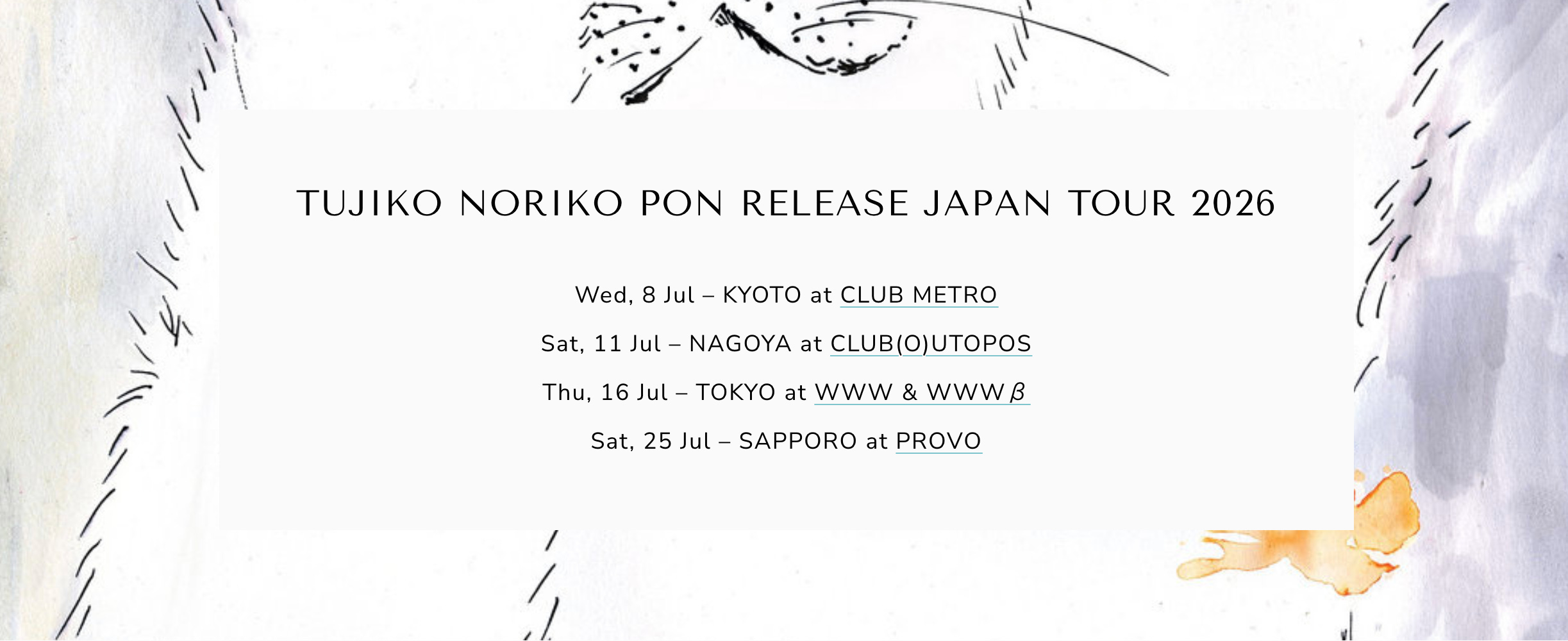
Hugh: Moving on from the new album, you’re off on your Japan tour next week. You’ve been based in France for so long that it must be very much your home, so what’s it like going back to Japan to perform, or generally?
Noriko: I feel I have a privilege of looking at only good things in Japan, like a guest. Me and my children are totally like many of our friends in France, you know, Japanese friends, Japanese families. They are completely happy, excited to go back to Japan. There is some kind of magic. I know too, if you are living there, that there’s a lot of dark sides, but I look at only the nice part of Japan. And yeah, how do I feel? You know, I feel at home, but of course if I went a little bit deeper I would feel a bit stranger as well. And you must feel… how long have you lived in Japan?
Hugh: I moved back just a couple of months ago, but I was here for two years during Covid, and yeah I think I can understand a lot of that. Obviously people treat me differently or expect different things because I’m foreign, but there’s a real sense of being able to enjoy it in a very superficial, privileged way. I try to not exploit that or take it for granted, but then sometimes I think can I have a deeper life here if I try? And then I question whether trying to have a completely ‘Japanese’ life and fit in completely would be an attractive idea even if it were possible. It’s a strange balance.
Noriko: I would say… I don’t know, it always has a good side and bad side. I’m here in France for about 20, nearly 25 years now, but I never really went deep. It’s possible, just to be… yeah, you can stay. It could be bad, but I ended up not assimilating myself to it... I couldn’t, you know. I just, I don’t go to the office, or just... yeah. It’s okay.
Hugh: Were you based in Paris or in the cities to begin with, before you started a family?
Noriko: Yes, it’s because of having children that took me to the countryside. If I become alone, then I would come back to the city.

Hugh: What’s one thing about France that you miss when you’re in Japan, and one thing about Japan that you miss when you’re in France?
Noriko: When I’m in Japan… often people start to miss food, right? So I guess me too. I might miss some tomatoes. Of course, there is human behaviour too. I would miss a good side… French people have a very big reputation that they are not really friendly, which is true, but there is a certain directness in their behaviour which makes things a little bit less stiff than in Japan. Yeah, I sometimes feel incredibly stiff in emotional expression in Japan.
And then, when I’m in France, I miss people’s very simple kindness. I feel, with strangers in Japan, they need almost permission to be kind or to be related, so maybe we have to ask for something, but if we ask – do you know, where is the shop? – they always help you completely until the end. It happens in France too, sometimes. But people are nice in Japan, they can be very cold too, probably, but there is a certain kindness. I miss it sometimes, and I miss all the food, fish… fish, oh my God, it’s crazy. In France it’s not possible to find fish like that.
Hugh: In the UK, too! I’m not sure why — France, at least, has less coast proportionally. In the UK, we’re terrible at putting fresh fish on the table. That was one thing I was really excited for here, but then again, finding French-style bread or cheese in Japan is a nightmare.
Noriko: Yeah yeah yeah! It’s totally wet — like if you buy a baguette, after five minutes, it’s soft.
Hugh: I bought one from this bakery the other day, and then the next day it was exactly like that! It was like a bread-shaped banana, I was really sad about it.
Noriko: Yeah, exactly!
Hugh: Could you tell us a little bit about your new improv project, CxBxT? How did that come about, and what are your plans for its future?
Noriko: There will be. I think I just saw on Instagram that I have to share the story with Adrian. Adrian is Adrian Corker, that’s why Corker – C – and then B is Barton, George Barton. He has this really great duo, in which he plays with his girlfriend. They assist a lot of musicians, because he has a classical background, so for instance, there is this very ambitious, very interesting musician, Oliver Leith: George played in his opera. He has a classical music career, but at the same time he made some electronic music. He does percussion, his percussion is really great. GBSR Duo is George’s duo, and then he’s the Barton in Corker-Barton-Tujiko, in CxBxT.,
I knew Adrian through a music supervisor with whom I worked on some film music, and then Adrian has been making musical films, so I met him and we got along. Adrian and I independently have the same agent for film music composition opportunities, and the agent said maybe we can look for a director or a film who can hire us together. At that time we didn’t have any music together, and the agent said that maybe we can try to make some quickly together, just to make an example.
Then I saw Adrian’s face, and then he was like no no no, we don’t have time, because Adrian kind of stopped making music for a while. He had a problem to keep making music — not a problem, but he was a little bit bored, because he does many other things too. So it felt like, oh, Adrian, you feel like it’s boring to make music with me? I didn’t say that, of course [laughs]. So we didn’t do anything, but I know Adrian: he’s very flexible, very open, very kind.
So after some months I had a small vacation, solo time without kids. I thought okay, I’ll go to London. I have some days. I will propose to Adrian to record something with me. He will not say no.
And then we recorded without any plan and without any re-takes, so the album has our very first take of each recording. In that sense, it was amazing to work with Adrian knowing that we both are not good musicians. We play instruments really badly, you know. We don’t have our instrument. Some can be a pianist or guitarist or bassist — we are nothing, and we play many instruments, but all very badly, but we did simple music with only one thing. After, we asked George to add some percussion. Well, it was made quickly, and now in a week, or very, very soon, that will be a remix album from this original album. Really nice remixes. Yeah, we wish to play concerts, but I don’t know when.
Hugh: Yeah, I saw the announcement for that – the remix album – go up just before this! I had an image of you pressing go on the announcement and then jumping into the interview.
So the music on the album after is you and Adrian doing a one-take, improvised performance of the whole album, and then the percussion was added later?
Noriko: Yes, most of the album was made like this. For one track we exchanged files, maybe two tracks were a file exchange, but otherwise it was all recorded in the studio, and then George added to it, and it made the music a little bit bigger. Yeah, so without George the original version was even more simple.
Hugh: While we’re talking about your collaborative projects, I saw that you remastered and reissued your album with Aoki Takamasa last year, 28, which… where is it? [pulls out an old CD copy and holds it up]. I love this album a lot, I used to listen to it all the time.
Noriko: Oh, thanks!
Hugh: For a deep-diving question, I saw that the vinyl reissue had a really different track list from the original version.
Noriko: Yeah!
Hugh: I was wondering if that was just to make it fit on two sides or if there was another reason behind it?
Noriko: It’s to make it fit, but I wanted to change the order. Because I’m not a huge music listener, sometimes I don’t have empathy for the listener. My friend Joji said to me, No, Noriko! Sometimes people hate that they change the order! [both laugh] Okay, sorry, I didn’t think about it!
Hugh: So there were any points when you thought this one should definitely have gone here to begin with, or something?
Noriko: Yeah, I just thought the order is nicer like this, because I think we had to reduce some tracks to make it fit, I guess some tracks are missing. I mean, the CD had a bit more tracks, right? And then the record has less, one or two, I don’t remember exactly. By reducing something, it changed the whole picture, or something. I don’t remember exactly why I wanted to change the order, but I thought [the new LP] order is nicer. I didn’t know that can be disturbing!
Hugh: I’ll try listening to it in the new order. I always loved how the last two tracks landed at the end of the old tracklist. I guess they’re now at the end of Side A, it’ll be fun to hear it a different way.
What was it like looking back at that music now? Had it been a long time since you’d thought about it or listened to it?
Noriko: By the way, Aoki-kun will DJ when I play in Tokyo, so I’m very happy to see him because he moved back to Japan a long time ago. When we made this album, he was still in Paris. I do remember he was in Paris when we were working on several tracks, I guess. I don’t remember… but then memory changes, right? So when we were interviewed for the reissue, what Aoki said and then what I would say was different, right? It’s interesting.
Hugh: What kind of differences?
Noriko: Like just where we were when we made this, or he was saying we exchanged files, like you know, distantly, it was quite distant, maybe… but I already had maybe half the tracks, and then like George, Aoki-kun added more sophisticated beats, and then mixed it in a cleaner way already for one or two tracks, even one track which is not on this album – “Karappo” – one track was on Make Me Hard.
And then when I was making concerts in the summer, I would play this track from Make Me Hard, but Aoki-kun was committing himself already to make “Karappo” a bit nicer with his beat. So we said let’s make more, more tracks…
And so when I listened back, which I never did until the reissue, I rather enjoyed listening to some tracks, which Aoki-kun initiated for the creation. We can hear it immediately — it’s totally different. I mean, it’s kind of one texture, maybe, because Aoki-kun mixed everything in a nice way, but some tracks are totally songs, and some tracks are abstract, so yeah, I appreciate listening to Aoki-kun-initiated tracks. It feels fresh. I appreciate his work, it gave a nice place to breathe in this album.
Hugh: I saw there was a joke that one of you – I think it was you – made about making a 51 album.
Noriko: Oh yeah, true! Yes.
Hugh: Was that a joke, or is there anything more we can hope for there?
Noriko: Oh, I’m totally motivated. We said that already when we were 40, I think, but I have to talk with him more in Tokyo, because there is his very solid attitude that, for some reason, he doesn’t really want to make music. I mean, even the concerts… he does a lot of DJing recently. Yes, he’s a DJ, and then he produced someone’s music, or he mixed it. I think it’s more that he kind of drew a line. He’s a little bit reserved from making his own music, and I wonder why. So already 10 years ago, if I say let’s make it!!, then he’s like yes, yes, and then he never does. So, I – [laughs]
Hugh: Well, fingers crossed. I guess he’s changed his style so many times since. I remember hearing RV8, the techno-style album he made [in 2013], and thinking wow this is great, damn, I wonder if this was his new sound and he stuck with it — and then, of course the next thing was totally different [and didn’t happen until years later].
Noriko: Yeah, I understand. Maybe it’s important to be that way as well. I’m quite loose about my self-image, and how you know, and how I produce myself. But yeah, Aoki has a more self-producing self.
Hugh: We touched on this earlier, but since PON sounds maybe the most similar that you have in a long while to the old work, how does it feel looking back to that time and the way you used to produce? Many parts of the album sound somehow cleaner or more precise, or you do things with electronics or some acoustic sounds that I don’t think your old work was leaning towards so much — is that something that makes you do you look back and think this is how far I’ve come, or okay, I just want to keep on exploring new things?
Noriko: I don’t have enough competence to self produce like… not strategy, but [deciding] which kind of style I would present next time. I’m not too conscious about it, and then, of course, at the same time, I don’t suddenly become a different person, and I don’t try to become a different person, so there is this limit. Also, in a positive way, it’s my style. In a way, I have only two differences in me, like it’s either I’m singing or not singing.
Hugh: What you said earlier about it being about the songs, or about space and ambience?
Noriko: Yeah, so it’s like for the next album, I will not sing. I was so happy not to sing only recently, though, and I found it’s really nice not to sing, so I will definitely do that again.
Hugh: Awesome! For some reason, what you said about not being a huge music listener didn’t surprise me much — within those two modes, your music has such a consistent style and personality to it. I can’t imagine you as the type to worry about who to listen to or who you’re inspired by.
Noriko: Yeah…
Hugh: Is there anything you have been listening to recently?
Noriko: I listen to a lot of music with my children, because living in the countryside, we have to drive, and while we drive, the kids are just playing music using my phone. And sometimes, you know – next mama! You choose – but I appreciate it because I like very pop music too, like Kendrick Lamar. I really like listening to Kendrick Lamar in the car, and kids shouldn’t… because, you know, you can sing the lyrics together, and they are not English speakers, so sometimes they have no idea, but they would copy the lyrics, and I’m like — [makes a shifty face].
But still, some Kendrick Lamar. I was making an NTS mix for new music, and then, for instance, I was introduced by my daughter to Charli XCX. Okay, yeah, some tracks are really cool, and recently there was this track with John Cale, very dark, it’s super cool.
Hugh: Oh, off the Wuthering Heights soundtrack!
Noriko: I love the story as well. I was really interested in this book, it’s crazy, I love this book Wuthering Heights, and I was interested in the film. I haven’t watched it, so I was interested in this album. So I was listening to this album, or I like, of course, more ambient. I always like Oren Ambarchi. I always find what he is doing is totally stylish, whatever he does, like very nice music. I was listening to Oren recently, or I found a Japanese band and I like noise music always, whenever. Especially if it’s a concert, I like noise.
With any music, if there is not a bit of experimental mood, I get bored. It has to have, for me personally, a little bit of humor, or a little bit of experimentation, a little bit of strangeness, or you know it’s free — and then, maybe it’s bad, but I quickly find it or don’t find it, and if I find it, I like it in any genre, any music. I’m not a big listener, but I’m totally always excited to listen to music, and if I listen to music, I’m just listening. Listening and driving is the max thing I can do, but if I’m in the room, and if there is interesting music, I just have to stop and listen.
Hugh: Like if someone’s playing music in the background and you’re at a party, you’re either listening to people or you’re listening to the music, that kind of thing?
Noriko: Yeah, and if I find nice music by chance, like in the party, I just need to listen to it! I get a bit rude.
Hugh: Like, if you’re at a cafe or a party, and maybe there’s a group of people you’re talking with, there’ve been times when I’ve slipped my phone out and been like, what is that sound?
Noriko: Yes yes yes, I understand [laughs].
Hugh: One last thing — you’re touring the album in Japan, but then do you have European dates when you come back?
Noriko: Oh, I think in autumn, October, something like that, but not a lot. I’ll maybe look for a little bit more. I need to earn money, of course, but as I’m not too much a fan of doing performances, so that’s fine.
Hugh: So, Japan for summer, Europe for the autumn, but not overdoing it. Well, awesome — thank you so much for everything you shared, it was really lovely to hear your insight.
Noriko: Thanks so much for chatting.
Hugh: Likewise!
Tujiko Noriko’s album PON is out now, and CxBxT’s remix album .After Again releases July 24th. Her latest NTS mix will air soon.
This got deep quick! She seems like a hell of a character, which is no surprise given the playfulness of her music. Wonderful chat ye've had here.
Having a brief scan of the new one atm and loving what I'm hearing. V excited to plumb its depths.
PON is so great and despite being more accessible than some of her older stuff nonetheless demands a lot of attention and patience, in the best way. Really loved the convo about living as a foreigner in various places; it's always validating to hear Japanese expats acknowledge the good and bad parts of living there.
Also great/heartbreaking/devastating to hear a more detailed account of the album's backstory. To me, the album reads perfectly as a eulogy or celebration of a pet's life: heartfelt and sad without anthropomorphizing its subject and bittersweet in all the ways that count.
Really cool interview with an icon. I wish I were back in Kyoto for the show there!