


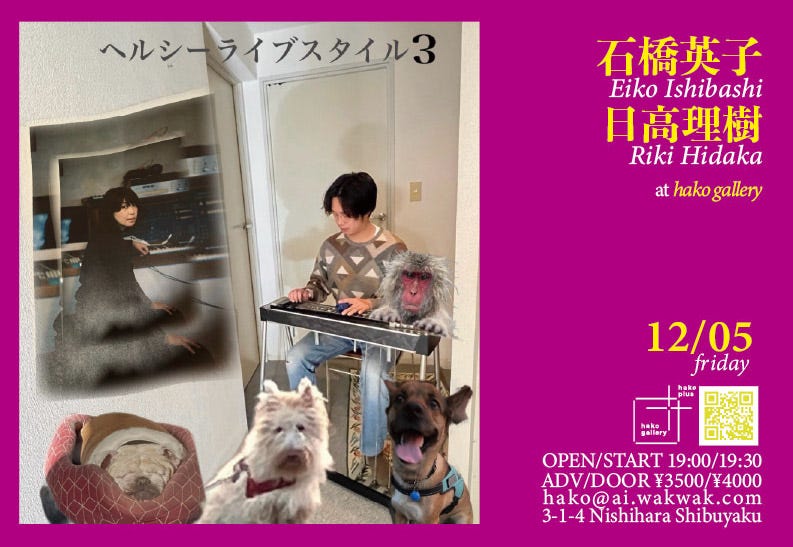
Hardly any preamble for this one: I hit up Tokyo for a four-day trip with the primary aim of shoehorning as many gigs as possible into my schedule. Landing on my first full day, Eiko Ishibashi & Riki Hidaka may have caught the worst of my jet lag and put on a tough show to describe musically, but their blend of pedal steel and EAI techniques were about as effortlessly engaging as anything I’ve seen this year. In we go!
If jet lag wasn’t enough to contend with, I’d spent the afternoon scrambling over the centre of town dealing with a logistical meltdown that meant I had to sit down with my friend I was travelling with post-Tokyo to re-plan the entirety of our ski trip. Things ended up okay, but I wound up arriving at the show hot, stressed, and, unpardonably, late! Lateness in Japan is always a downer, partially because it’s culturally unscored as such, but mainly because nothing is ever delayed unless there’s a literal natural disaster to blame (as there was just a few days later); lateness is always your fault, and don’t you know it! As a Londoner with an entire half-functional city’s worth of excuses not to arrive on time for anything, this has always been one of the hardest things to adjust to in Japan for me: don’t eat in public, don’t talk on the train, don’t be late for anything. I digress.
In any case, the Hako Gallery is a small loft space with a bar; there’s a few rows of seats near the stage, but the last thing I want to do is make a scene eight or so minutes into the performance: you couldn’t cut the audience’s silence with a butcher’s knife. I’m instantly preoccupied with depositing my bags without disturbing the dreamlike soundscape that seeps through the air thick as syrup, though I cannot tell which instruments are making any of the sounds. There is no light anywhere except for the stage. I sit down slowly on the edge of the nearest stool, which turns out to be a stack of stools, which immediately starts to fold in over itself until I shift my weight to the centre. I wince as the metal legs scrape against each other, and look up to see the stage for the first time.
Eiko Ishibashi is playing the flute into a microphone. with one table in front of her (covered in cables, wires, a sampler and a computer monitor), and one on her left (which as far as I can tell contains several pedals/modulators and a mixing board). She’s kitted out to weave any number of the ambient/electroacoustic tapestries I’ve come with a loose expectation of: beyond her art pop solo records and heavily decorated oeuvre as a film composer, these are perhaps what she’s best known for (they’re certainly her most prolific suit anyhow). Most of what I’ve heard from her has caught my ear without snagging my heartstrings, one major exception being this astounding collaboration with jazz pianist Hiroshi Minami, but whatever comes of this show, I’m excited to get a little more insight into her process.
On the other hand, I’ve never heard anything from Riki Hidaka’s end of this collab until now (though they’ve previously recorded together with Jim O’Rourke), and I’m eager to get a good read on him as such. This is instantly complicated by how obstructed my view of him is by the person in front of me. I will see later that he is sitting behind a pedal steel guitar, which he plays more or less continuously throughout the performance, and a maze of pedals, but I initially assume he is playing a keyboard (the texture of his instrument is as gorgeously diffused and reverberated as any synthpad), and since his movements are minimal and delicate, my initial impression is that he is simply tapping on some portentous, sonically-endowed table.
In his beanie and flannel shirt, he seems completely relaxed and his notes flow forth in much the same fashion, each in its own time. On the other hand, Ishibashi rocks a deerstalker and a down jacket, and because (as I later realise) she sits facing the corner of the two tables, her body twisted to face the audience and the mic, her legs are somehow positioned in a blind spot under the table. This wouldn’t be worth mentioning if it weren’t for how the three legs of her metal stool and the two forward-facing legs of her mic stand happen to intersect, giving the impression that her torso has emerged from some spidery android frame.
It makes an entertaining contrast with her down-to-earth garb, but as far as her performance is concerned, it could hardly be more apt: when she’s not playing the flute or harmonica (which tends sampled and looped rather than sustained as improv), she’s ensconced in the tech, constantly adjusting the mix, hammering into a sampler, juggling loops, tweaking various dials to the left and right, and goodness knows what else.
I have no idea what she’s doing half the time, but in contrast to Hidaka’s gentle immersion in the slow, gliding tones of his instrument, she’s a hive of activity, never sat still at any point in the performance, and never doing the same thing for more than a minute or so. It’s hard to tell how exactly her handiwork corresponds to the soundscape, with its murky convection of layers, but it is dynamic — whether she’s building into Hidaka’s performance or drawing it into a broader canvas (it is often hard to tell), Ishibashi negotiates such a multilateral push-and-pull act that that the music always has the sense of being pulled towards some unseen direction.
As far as structure goes, the pair play two sets with a short interval in between. The first set is the more intense: once the soundscape has churned its way to a thunderstorm’s worth of tension, Hidaka’s overdriven tones pierce it like the cries of some primordial bird-of-legend heralding an imminent downpour. He plays more overtly against Ishibashi’s swirl of textures than at any other point, the two gradually ratcheting up the drama of the piece without ever allowing it to taper into a gauche crescendo. I’m gripped; I have no recollection of how they brought the intensity back down, but the piece unravels just as naturally as it has come to a head.
The second set was relatively reserved, and much more contingent on zoning into the ebb and flow of nebulous layers — which is to say, it was fleetingly angelic, but finally got the better of my jet lag. Too oneiric to handle! I found myself drifting off and snapping awake in roughly two-minute cycles, and I can hardly ‘review’ the performance as such. However, there was something powerful in how the soundscape cushioned those snaps back into self-consciousness. Was it obvious that I had drifted off? Did I twitch conspicuously when I woke up? One moment’s anxiety at having offended the vibe would immediately be swallowed up by the reverie, at which point I’d have a good minute or so of floating along with it before it inevitably pulled me under.
Optics of attentiveness and respectful audience-ing aside, I wonder if dozing off in ambient performances can’t be framed as valid participation — the show’s katakana title (top of the poster) can probably be construed as an invitation: Healthy Live Style. Back home, I serially nap to music specifically because of how it often feels like a current flowing in and out material reality in the half-asleep/half-dreaming state (sounds like pretentious guff? try it!), and although this concert wasn’t outright dissimilar, it was strange to be actively fixating on such a dreamy soundscape as the main thing tethering me to reality! Perhaps I’d have been better advised to go to the Goethe Institute, which was running a series of shows on isolation, dissociation and reflection last week. Seiichi Yamamoto (ex-Boredoms, of whose solo album Crown of Fuzzy Groove I’m a big fan) was on their bill a few days later with a particularly appealing take on the theme…
On Dec 7th, Seiichi Yamamoto performs a solo set that artist, audience, and staff all experience while lying down. Please bring a pillow. Yoga mats and sleeping bags or blankets also recommended. Limited admission.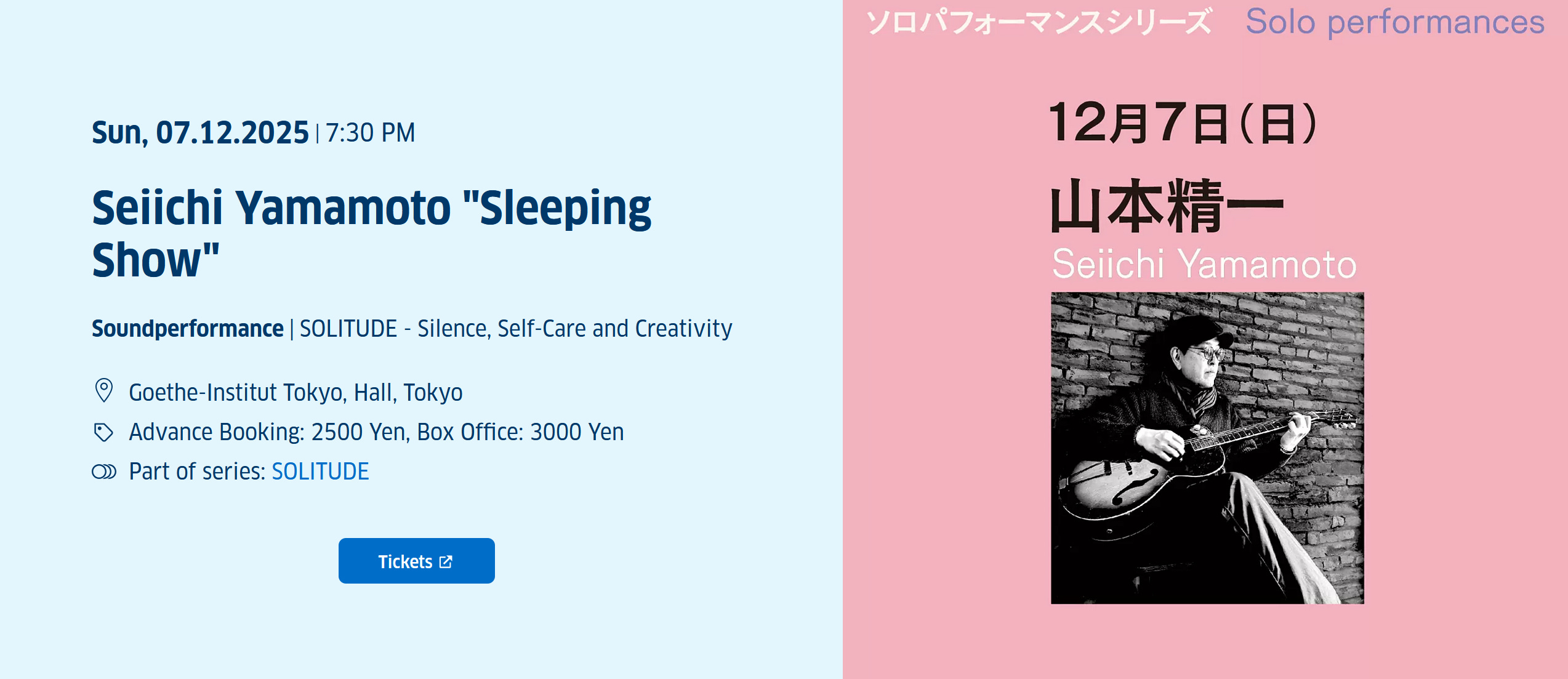
…but ultimately, the Ishibashi/Hidaka gig restored my energies and I was up to more volatile fare by then (stay tuned for that post). This was a good show in its way! Not just because much of the performance was self-evidently gorgeous or because it made for a great introduction to Hidaka’s ambient guitar stylings, but because witnessing Ishibashi’s fastidious approach to sound design in real time has absolutely motivated me to pay more attention to the textures and layering in her studio records. More to come from this journal soon, but here’s a few of those to tide you over meanwhile: