

SEVEN #1: seven songs about the number seven
A series of all time is born! Scott Walker, Seven Harris, Sonic Youth, Seiko Oomori and more get the sevenparse of a lifetime...

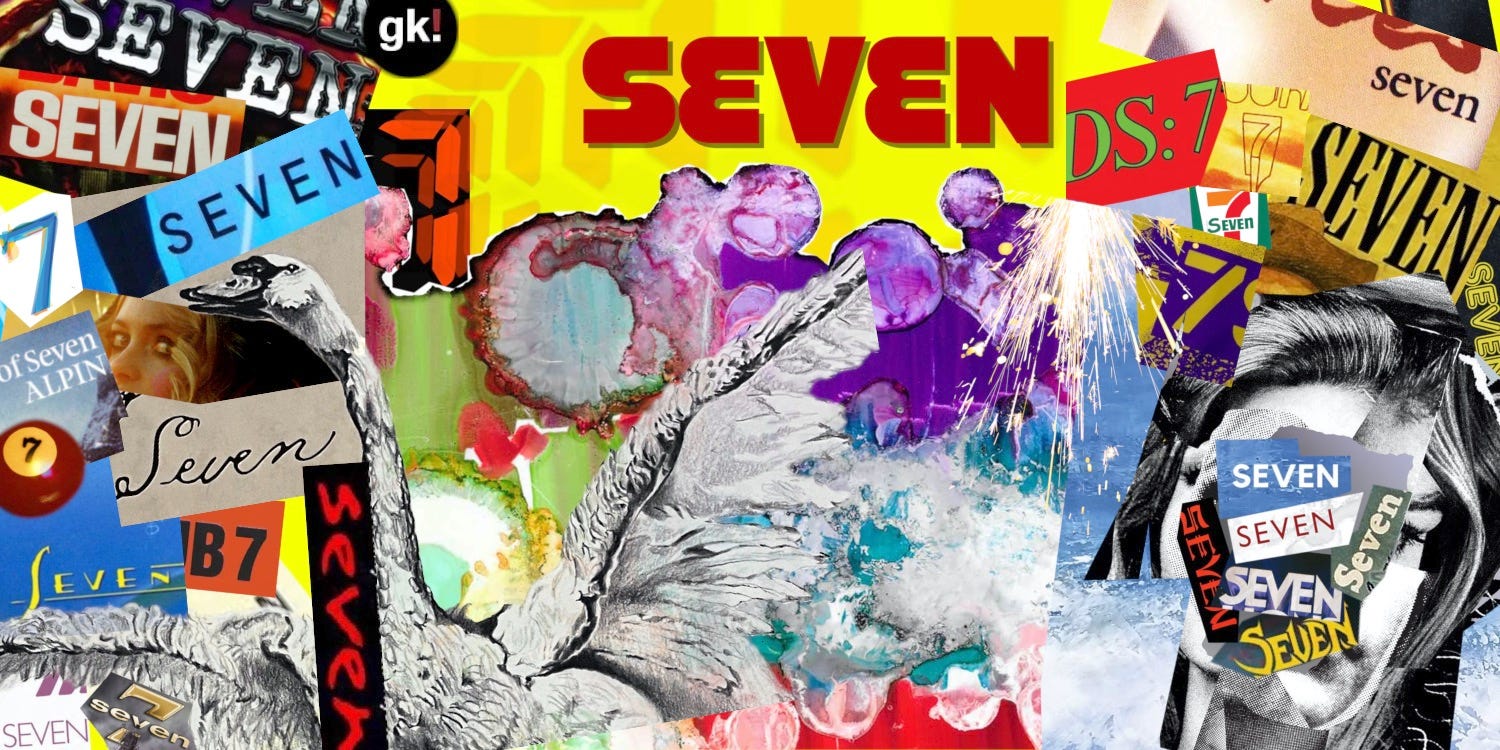
SEVEN is your brand new, weekly feature dedicated to all gripping music discourse in orbit of the number seven. There is literally nothing it cannot be as long as it is held together by a seven, and as all sevenly things are excellent, you are in for a treat. Buckle up.
Welcome to our inaugural instalment of SEVEN, in which both you and I endeavour to discover exactly what this series will constitute and why its progress will be unstoppable. Seven is a number and its power level is pretty freaking high. What can go wrong? Our lovely rotating gang of contributors will be taking turns to bestow its mysteries upon you, and you can read some of their hopes and dreams for the series here:
As per the edicts of orthodox powerpoptimism, I cannot formally contribute to SEVEN, as it acknowledges the existence of music made in the 21st century. Leave all the blasphemy to my brilliant, demented colleagues! They’re gonna educate, entertain and hopefully offend your delicate se(ven)sibilities week after week, and you’re gonna like it! - Kerry
I hope to be employed approximately SEVEN months from now and maybe also be happy - Jesper
Wish I could open Substack dashboard on my phone - Ben
Amazing. And so, without further ado, here is SEVEN in its purest and least imaginative form: seven tracks connected in name or in tangential reference to our kickass eponym. Here they- uh, here they are!
Scott Walker - “The Seventh Seal”
from Scott 4 (1969)
Now I don’t know about you, but if I ever saw a hack journo take a shot at this list theme without including this particular track, I would firebomb their inbox and throw their doubtless poxy record collection into the sea. ‘Why?’ you ask — how dare you! Why? Why is “The Seventh Seal” so iconic even among iconic seven songs? Is it because it opens – and marks an instant highlight on – the final, (perhaps) most acclaimed record Scott Walker released at the peak of his commercial powers? Is it because Walker is spoilt for source material in his synopsis of Ingmar Bergman’s macabre 1957 fantasy by the same name, in which a medieval knight plays a desperate game of chess against Death himself to ward off the end times? Is it because the song’s string arrangement is likewise pure kino? Does one need a single defining reason when they’re dealing with a classic as self-evident as this? Gallop along with this one before Death swings by to harvest your entire trove of sevens!
Pixies - “Monkey Gone to Heaven”
from Doolittle (1989)
You all know the score for this one, and if you’re not singing it I’m fucking singing it:
If Man is five, if Man is five
If Man is five, then the Devil is six
Then the Devil is six, then the Devil is six
The Devil is six, and if the Devil is six
Then God is seven! Then God is seven!
Then God is seven!
So it goes. What’s it in reference to? Apparently a Hebrew numerological sequence that Black Francis caught wind of, did zero further research on, and jotted down for the hitmaking bridge of what proved to be perhaps the most enduring classic his band ever put to tape (we’ll brook counter-arguments from the “Debaser” or “Hey” crowds, but get out of here with any “Here Comes Your Man” antics). No substance and all passionate, throat-rending SEVEN? A man after my own heart, and arguably the most iconic and enduring reference in all rock music to that greatest of numbers.
Sonic Youth - “Stereo Sanctity”
from Sister (1987)
SEVEN!!! may most assuredly be the digit hollered over this track’s opening seconds, but otherwise the connection is loose: “Stereo Sanctity” is perhaps the most abrasive banger on Sonic Youth’s noise-pop opus Sister, and its profane assault on language, logic and melody leaves no place for humble mathematics. See the following for one of my favourite bullshit verses in the whole fuckheaded indieverse:
I’m keeping my commission to faith’s transmission
Two speakers dream the same and skies turn red
Satellites flashing down Orchard and Delancey
I can’t get laid cuz everyone is dead
You tellem, Thurston Moore. Fortunately for the Sonic Youths, I’m willing to extend a plus-one to “Monkey Gone to Heaven”, in part because Black Francis had the good sense to declare GOD IS A SEVEN two extra times, earning him an extra slot by divine sevenly invocation, and in part because of an enjoyable tie-in I came across on a talk show archive trawl, where Mr. Moore and Mr. Pere Ubu (aka the late, great David Thomas) react to none other than that very same Pixies tune live on air in 1989. Neither was a fan of its music video — not should they have been, for it is indeed a pile of arse! — but at least Thurston was gracious enough to concede the Pixies were an okay band.
Some anonymous opinion-haver in the YouTube comments claims that the Pixies were out of Sonic Youth’s league but I couldn’t agree less. I’ll always admire the Pixies (specifically Doolittle) for how many jagged edges they worked into lean, mean, facetiously camouflaged pop songwriting, but their pre-hiatus discography rests a lot of its reputation on zany juvenilia and has aged conspicuously for me, including Surfer Rosa — can you honestly call to mind a single earworm from that album’s scattershot Side B, post-”Where is My Mind?”?
By contrast, Sonic Youth’s best and even second-to-third best efforts sound as great to me as ever, perhaps because a much greater proportion of the acts they inspired have a generous measure of their own sauce (see this absolute belter of a Taiwanese noise pop album that my buddy Liam quite rightly pointed out is essentially EVOL in party mode), but mainly because any band founded by two Glenn Branca apprentices and a trained artist were always going to have more going on aesthetically than an ear for a good hook or memorable chorus.
Not to get too snobby about credentials, but the proof really is in the pudding and the members of Sonic Youth’s collective ability to dish out exciting, enduring experimental music from the very start to the literal present day speaks for itself. Easy as it is to malign Thurston Moore for his ‘90s arrogance (see 3:24 for a seven-inclusive number joke too cringe to be cited even in this feature), ‘00s commercial stoogery and ‘10s band-torpedoing infidelity, one trip round his 2019 solo guitar marathon Spirit Counsel should be enough to convince anyone that the man’s work in minimalist/drone/noise guitar is far more substantive than any of the waves of indie vogue he used to nourish his ego on (perhaps still does? is maybe too busy – see his 2025 top 350 releases list that I would love to have embedded before it vanished from Substack along with the rest of his account? is that the life-changing resolution the naysayers have been waiting for?).
If you want a similar testament to Kim Gordon’s unfading talent for transfiguring the most off-the-wall imagery you ever heard into liquid cool, 2024’s Grammy-nominated industrial-trap record The Collective should do just fine. Present-day Black Francis, on the other hand, is a washed-up crank holding a zombified version of a once-classic act up by its bootstraps. The force, as they say, has always been strong in You[th]. Ugh.
For want of another way to terminate that post-ruining digression, it has also just occurred to me that “Brave Men Run (In My Family)” would have been a much more appropriate choice for Sonic Youth, with the (clearly) unforgettable seven days and seven nights refrain in its first verse. Whoops — but, as they say, the flow of sevens marches in only one direction, leaving no room for sorrow or regrets. Only sevens.
Oh well, “Stereo Sanctity” bangs harder anyway.
Seven Harris - “So Fun”
from Seven Harris’ YouTube page (2024)
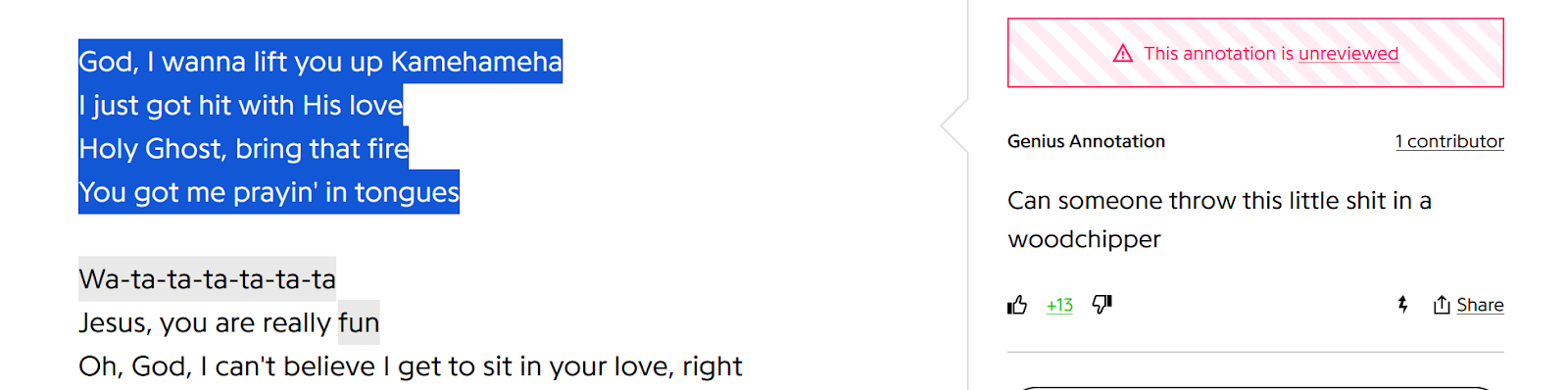
Enough parping about indie progenitors! It is time for the future of God rap: Seven Harris is a motherthanking ten-year-old from America the internet, his dad manages the YouTube page upon which he lays down bars for Jesus, and I am (uh) proud to say that I was aware him long before the thought of putting this feature together ever came to mind. True to its title, “So Fun” is an immensely fun song-listicle about all the infinite yet strangely countable ways that God is great fun (cheese, hugs, water guns, lalalalala, great flow, yes), and all I can say is that if the big man ain’t a seven, then Seven is (uh) ten. The Devil remains a six, happy Easter.
Seiko Oomori - “7:77”
from Kusokawa Party (2018)
7:77 is the best time of day to get anything done. There is no better time for anything, and before you graceless dogs start complaining that it only comes twice a day, let me stop you right there and insist that no! It is always 7:77 and you can bloody well get down on your knees and praise all your gods for this, and also Seiko Oomori because doesn’t she damn well know it. On “7:77” she certainly did: this song is a frankly omnipotent miracle of pop-metal energy that flexes that most dubious of genre fusions with (I dunno, probably) unparalleled parity, partly because it’s catchy as sin, partly because Seiko Oomori’s background in nails-on-a-chalkboard folk punk grit affords her the chutzpah it takes to belt shrill thunder over an instrumental one small step away from Dragonforce and come out un-debased by the experience.
Lore/language-wise, this one runs unexpectedly deep — even as a longtime fan of Seiko Oomori in her distressing ups and downs, doing my homework for this one was an eye-opener. The title (pronounced Nana Nana Nana) is a play on the Japanese word for the almighty number SEVEN and Seiko Oomori’s stuffed bear mascot, Nana-chan (previously immortalised on the track “ナナちゃんの再生講座” (Nana-chan’s Resurrection Party) from her 2014 masterpiece Sennou).
The lyrics as such offer various colourful illustrations of the role said bear plays as stress relief while taking relish in the persona of an overstimulated brat in need of exactly that, and the sevens simply do not stop coming. Take the volatile pre-chorus:
なんにも満足できないな 7:77
天才でまじごめんなさい 7:77
ナナちゃんは今日もめっかわ 7:77

なんかないないない7つない
なんかないないない7つない
なんかないないない7つない
なんかないないない

And nothing satisfies me at all, naa-na-na, naa-na-na
Seriously, I'm sorry for being such a genius, naa-na-na, naa-na-na
But Nana-chan’s looking adorable again today, naa-na-na, naa-na-na

And like, no, no, no, seven times no!
And like, no, no, no, seven times no!
And like, no, no, no, seven times no!
And like, no, no, no...

CRITICALLY IMPORTANT NOTES

[1] Those naa-na-nas are indeed her belting the title.

[2] By happy coincidence, the second part of the pre-chorus (ないないない / no, no no) boasts the meanest riff in the song, on top of which includes a total of seven “な” (na; the parent sound for nana (seven)) characters per line.

[3] That same part lurches pulls a 7/4 time signature shift before barrelling into 4/4 for the chorus
“7:77” is also the seventh track of Oomori’s seventh album, if you count her five previous solo LPs and then exactly one of her debut minialbum PINK (2012), her indie rock spinoff Tokarev (2015) or her unplugged reworkings album Muteki (2017), which I’m guessing she did because this decision seems far too deliberate for it to be otherwise. Which one did she count? Fuck me if I know; go and ask a psychic or her ex-husband. How many more stars do you need to align before you get down with the reality that it is still 7:77 and there’s a world of potential waiting for you. Get out there and fucking achieve something!
Traumprinz - “7”
from Blue Turtle (2023)
(play from 26:58 to 34:06 if the timed embed doesn’t work)
If all that seventh-song-of-a-seventh-album bullshit strikes you as too full of bullshit, then excuse me while I make room in this pew. Let’s dumb things down and remember that while track titles are a construct and numbers are an eternal constant sometimes it’s easier when all songs are simply named for being the first/second/etc./seventh item on their tracklist and the comfortable sequencing from “1” to “2” matters more than any conceit of individuality they care to bring to the table. “7” isn’t a bloody Fall Out Boy song, it’s a dreamy melodic apex on an ambient trance mix, and damn it well knows it. Eat your cake.
The complexity here if you’ve quite finished wiping your punk-slob mouth lies in that Traumprinz himself goes by a string of aliases (Prince of Denmark, DJ Healer, DJ Metatron, Irini etcetc.), which by some miracle of talent are more or less equally celebrated despite their shared penchant for eye-watering runtime — and the un-sevenly reason for giving Blue Turtle generally and “7” specifically a spotlight here is that its evocation of heyday ‘90s cheese cuts a welcome contrast with the post-club whimsy of his other trance output (insofar as I’ve sampled it; it can never always be 7:77 enough to sift through those whole back catalogues, yeesh). So yes. Who said your New Age synth escapes can’t be still delivered in lurid lights and ear-grazing saw waves in this godforsaken decade of the wrong century? Not, ehm, not “7”!
Tarwater - “Seven Ways to Fake a Perfect Skin”
from Animals, Suns & Atoms (2000)
We will close with the best closer possible for this list: “Seven Ways to Fake a Perfect Skin” is a died-in-the-wool SEVEN champion in that its title begins with the magic word, in that its title is also a lyric, and in that its lyric is also the refrain line — but if that’s not enough, it is also the literal closer for Tarwater’s early 00s deutschtronica indie gem Animals, Suns & Atoms. Amazing. I hadn’t revisited this song in approximately a decade until making this list, but I am glad to hear that its vocal delivery is as terminally leaden as ever even by the standards of early-oughts German indietronica, that its hazyboi kaleidoscope of textures still delivers synthetic magic, and that its treatment of actual synthetics (the titular perfect skin) still just about sardonic enough to provide a veneer of substance for a song as otherwise incorrigibly spangled as this.
So what are the seven ways to fake a perfect skin? Well, uh, wouldn’t you like to know! Find out next week. SEVEN come more in soon / love / take care.