


38:13 // January 16th, 2026 // Columbia
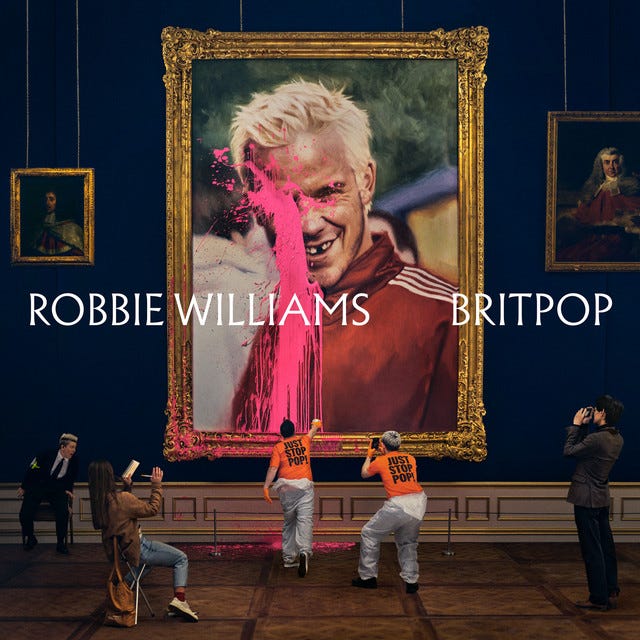
Somewhere between the gag reflex-prodding wedding-dance sap of ‘‘Angels’’ clones and the genuinely erudite lyricism of songs like ‘‘Advertising Space’’, Robbie Williams has always been the best and worst of UK pop, his quietly legendary status as pop royalty notwithstanding. Take That served as his launchpad, but leaving it undoubtedly allowed him to stretch out artistically in more meaningful ways than the band ever did as a collective, and his violent lurches from idea to idea as a solo artist are intriguing, if increasingly nauseating, to witness. BRITPOP, its release delayed so as not to compete with the fawning adoration that Life Of A Showgirl so obviously deserved, is a record Williams opines as the one he wanted to make back in ’95 after his initial departure from the band. It’s an alternative history of sorts: the simple title promising — and delivering — swagger, heritage, and more than a pinch of self-mythologising autofellatio. It lands after years of Williams surfing the wastewater dregs of his own cache (with the exception of a money-spinning Christmas album, which is assuredly below the creative waterline), but as a creative direction never taken, it at least sets out to take some risks.
I’ve always contested that Williams’ 2002 record Escapology is one of the best mainstream pop records of the noughties. He took more control on production, wrote openly about the psychological toll of fame, and the adventurous mix of pop rock, balladry and left-field oddities (not to mention his most surreal and entertaining song to date, ‘‘Me And My Monkey’’) came across as both well-rounded and sincere. Though not perfect, it managed something that Robbie frequently struggles with: balancing ear-candy hooks with lyrical sharpness. Despite circling similar themes of fame and self-reflection, BRITPOP mostly misses both sides of that equation. And that’s even with Tony Iommi showing up for a solo.
There’s a heavier emphasis on raw guitar driven tracks on BRITPOP, go figure, and by ‘heavy’ I mean so committed it’s bordering camp. Distorted, driving riffs keelhaul simplistic melodies, leaving the songs reliant on vocal contributions to create memorability — which they very rarely achieve. ‘‘Pretty Face’’ sketches a reflection of the surface shimmer that pervaded the Britpop era, but forgets to install anything interesting under the hood, the lack of dynamism and grating vocal overlays flattening the sound even further. Cuts like ‘‘Bite Your Tongue’’ and ‘‘You’’ attempt to compensate with brighter guitar tones and a more playful pulse that do actually elevate the compositions aesthetically, but that vibrancy serves as little more than a distraction from deadweight hooks that do nothing with the space they’re given. One of the more successful songs in this lane is ‘‘All My Life’’, which feels spiritually adjacent to Oasis’ Heathen Chemistry era. It’s likeable, structured, and even catchy in flashes, but like late-era Oasis themselves, it plays back the past rather than recapturing it. The lyrics, uninspired as they are, don’t help any in selling the illusion.
When Williams isn’t cosplaying his best Britpop self, he’s rummaging through his own archives, seemingly whizzing career offcuts at the wall in the hope that something will adhere. ‘‘Spies’’ echoes ‘‘Lazy Days’’ (Life Thru A Lens), but doesn’t build anything meaningful from that template. ‘‘Cocky’’’s minimal swing is reminiscent of ‘‘Man For All Seasons’’ (his Hans Zimmer-assisted effort for the Johnny English soundtrack), but is nowhere near as fun or memorable, being weighted down by a bland chorus and a hook that bypasses the earworm station and instead gets off at irritating. ‘‘Human’’ and ‘‘Morrissey’’ showcase some of the LP’s stronger songwriting, however, with the former feeling like an Intensive Care extra and the latter toying with stripped-down Rudebox-adjacent electronica. The synth bass and twinkling chorus details of ‘‘Morrissey’’ are hardly revolutionary, but they afford the track a strong sense of motion and personality — both things BRITPOP is in dire need of. Robbie sounds adventurous, flirting with unusual influence — explorative, instead of committed to a dated costume.
In its 38 minutes, BRITPOP doesn’t do anything offensively bad, but it also never leaps out of the blandness it seems content to reside in. It simply swings its legs in the middle ground, too safe to fail spectacularly, too stiff to succeed quietly. The lyrics offer a cursory skim over themes of nostalgia and self-awareness, but don’t dig meaningfully into either, leaving a lot of the heavy lifting to the music itself. The LP fails on this front, not just occasionally, but persistently: whenever infectious interplay between instruments or interesting songwriting threatens to materialise, it’s immediately smothered by rigid structures and oddly joyless production choices. The few moments that work do so because they expand out of the album’s unnecessarily restrictive box and dare to sluice previous Robbie sounds into the mix. It’s a shame, because buried underneath all of this, there’s a genuinely interesting idea.
BRITPOP allows Williams to romanticise the sound he never fully had while simultaneously glancing back at the one he actually built. It’s an expression of double nostalgia: the road taken, and the road ignored. The unfortunate reality is that neither approach gets enough personality to feel uniquely his; he borrows sonic forms, eras and moods, but so infrequently shapes them into something personal that the album just feels like a collection of retreads. And fair enough, it mostly plays like a tribute to a bygone era, but when an artist can’t meaningfully contribute to an historical sound OR bolster his own, it doesn’t feel offensive — just strangely hollow, and wasteful. Of course, there’s nothing inherently wrong with looking back… so long as you remember to move forward at the same time.
3.5/10