

REVIEW: Kevin Morby - Little Wide Open
Our prayers stuck up in the rafters

59:16 // May 15, 2026 // Dead Oceans
Kevin Morby holds the odd and rather unenviable title of my least favorite artist who I listen to a lot. How he achieved this position is a long story, but essentially goes like this. A full decade ago, the folk artist released Singing Saw, which, while far from a perfect record, had a number of incredible songs and an overall atmosphere which scratched a particular itch. Subsequent efforts consistently proved disappointing to me, mostly proving bland and unambitious, with Morby’s lyricism, never exactly his strongest suit, dipping into occasionally actively bad territory. However, utterly mysteriously to my ears, Morby’s career continued to ascend during this period, with him emerging as one of the more acclaimed and popular artists in the indie folk scene. That development meant his new music was always in my face, and I liked his material just enough to be perpetually curious, rather than annoyed, by these constant reminders. My reaction to the three album stretch following Singing Saw proves that, contrary to George W. Bush’s timeless wisdom, you can get fooled again.
That limp and uninteresting era of Morby’s career was broken by the 2022 release of This is a Photograph, an album which was nothing if not ambitious, aiming to create a thematic set of songs documenting, as the Bandcamp description says, “history, trauma and the grand fight against time”. Sounds pretty great, but the results came very near to putting me off from checking any future Morby releases for good - that album contains multiple great songs, but as some grand statement, it’s egregiously lacking, and the lyricism was frequently stunningly poor and unable to articulate anything meaningful. All in all, it was enough to make me think the flaws that Morby had been unable to rise above since Singing Saw would consume his career.
It’s a simple passage on the Bandcamp description (turns out I like reading those) of Morby’s latest, Little Wide Open, which convinced me to give his music one more chance:
As Rachel Kushner writes of Morby in the album’s accompanying essay: “It’s about time, about feeling like he has shifted from nostalgia and the losing game, losing but beautiful, of holding onto the past. He has accepted that time is ceaselessly flowing, and you can’t stop it. Instead, he feels like he’s riding it. He’s riding passenger with time.”
This whole idea resonated pretty deeply with me - not to get all philosophical, but I’m increasingly convinced that finding some way to deal, personally, with the inexorable passage of time and the impermanence of you and everything you love is the great universal struggle, but also somewhat underrepresented in the world of music, perhaps because it’s such a thorny subject. Anyway, I can’t say that reading that restored my faith in Morby’s ability to craft an excellent album, but it at least made me intrigued.
I’m sure glad it did. By every metric, Little Wide Open blows all of Morby’s post-Singing Saw releases out of the water, to an astounding degree. Indeed, I’m almost certain this is a stronger overall record than Singing Saw, as well. In whatever way you want to judge a folk album - lyricism, instrumental arrangements, atmosphere - this is a huge step up, and indeed a masterwork, all the more impressive because this is also Morby’s most sprawling LP. The album is the musical equivalent of a once-hyped NBA lottery pick feeling like a bust for a few years before finally putting it all together and taking the league by storm. As a Blazers fan, Scoot Henderson, looking at you - please pull a Kevin Morby next season.
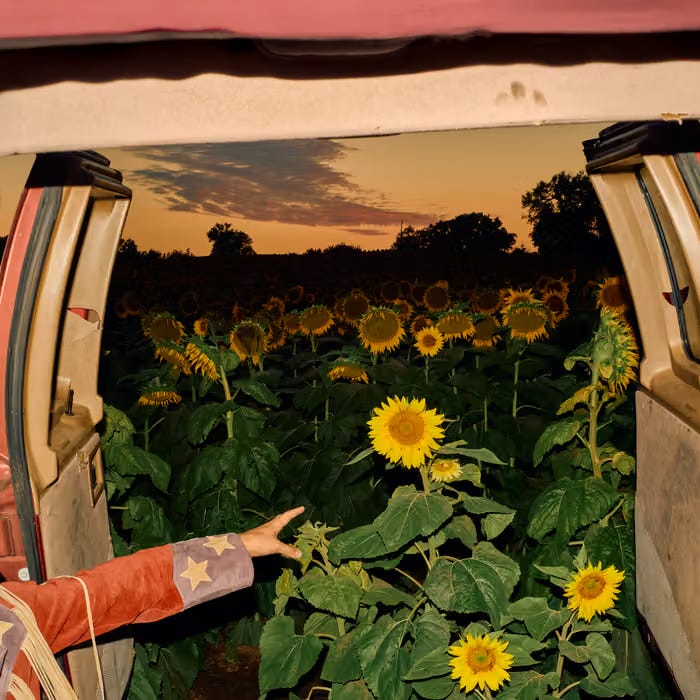
Clearly well-produced (by The National’s Aaron Dessner) yet feeling organic, these thirteen songs are steeped in the rhythms and culture of Morby’s familiar Midwest (he’s spent much of his life in Kansas City) - these are odes to the simple things in life, populated by recurring references to tornados, roadside churches, fireflies, junebugs, all with an elegiac quality, portraying a picturesque landscape inside a decaying empire as our time inevitably dwindles away. This album contains much of the boldest instrumentation and many of the richest melodies in the discography, but even its frequent mellower moments lean into a rustic dreaminess which compliments the effortless profundity of Morby’s voice, long his best asset.
Despite feeling much less imposing in its aspirations than This is a Photograph, Morby’s latest feels far more rewarding as a journey, even ignoring the clearly superior quality of the songs. Adopting a more reflective lyrical tone, eschewing attempts to make a big statement with simple words, perhaps surprisingly, the messages here come through more strongly, and with much greater depth than its predecessor. Its beautiful yet depressing portrayal of heartland backwaters is powerful - the hollowed-out small towns, the broken promises (“Is a dream a lie if it don’t come true, or is it something worse” - Springsteen has a line for every occasion), the performatively huge crosses and omnipresent churches, all representing a land and a culture rotting from within, ending up with a living personification of the Seven Deadly Sins in the White House - with a graceful and thoughtful hand, Little Wide Open captures both a personal sense of loss and expands it to a national scope in a way that its predecessor struggled so badly to do. All it took was a softer touch.
I guess that’s not all it took. These songs themselves are very strong - “All Sinners” is absolutely beautiful, as well as dipping more strongly than most into the record’s religious themes, “Natural Disaster” is a sublime epic of a tune, and “Bible Belt” is gentle and flowing in the best way, to name just a few highlights. Not to mention the centerpiece and title track here, which is to my ears the best song Morby’s ever penned - a sprawling, country-tinged meditation that I never want to end. All told, there are thirteen songs here, and any of them would be highlights on any of Morby’s other records released in the last decade. It’s truly inspired stuff.
The album title feels like a winking twist on Tom Petty and the Heartbreakers’ Into the Great Wide Open, and if I have no proof of that theory, it does feel like a similar kind of record - comfortable, melodic, rural - even if this one is considerably more melancholic in tone. I mention that because Kevin Morby has always been a traditionalist, his music clearly inspired by the folk and heartland rock greats of the past. This isn’t really any less true here, but the results are more confident, more layered, more transcendent than ever before. Little Wide Open is the first time I’d feel comfortable putting a Morby album alongside the best of one of his idols, but this time around, man does it feel right. All that’s for another day, though. For now, I’ll just say this is one of the finest records to come out in 2026, from an unlikely source. You love to see it!
8.5/10
Surprise of the year, here, for me. And one of my favorites!