

REVIEW: Erina Uozumi – Eien nante
Heavy hearts and empty skies: underground folk luminary makes the form her own

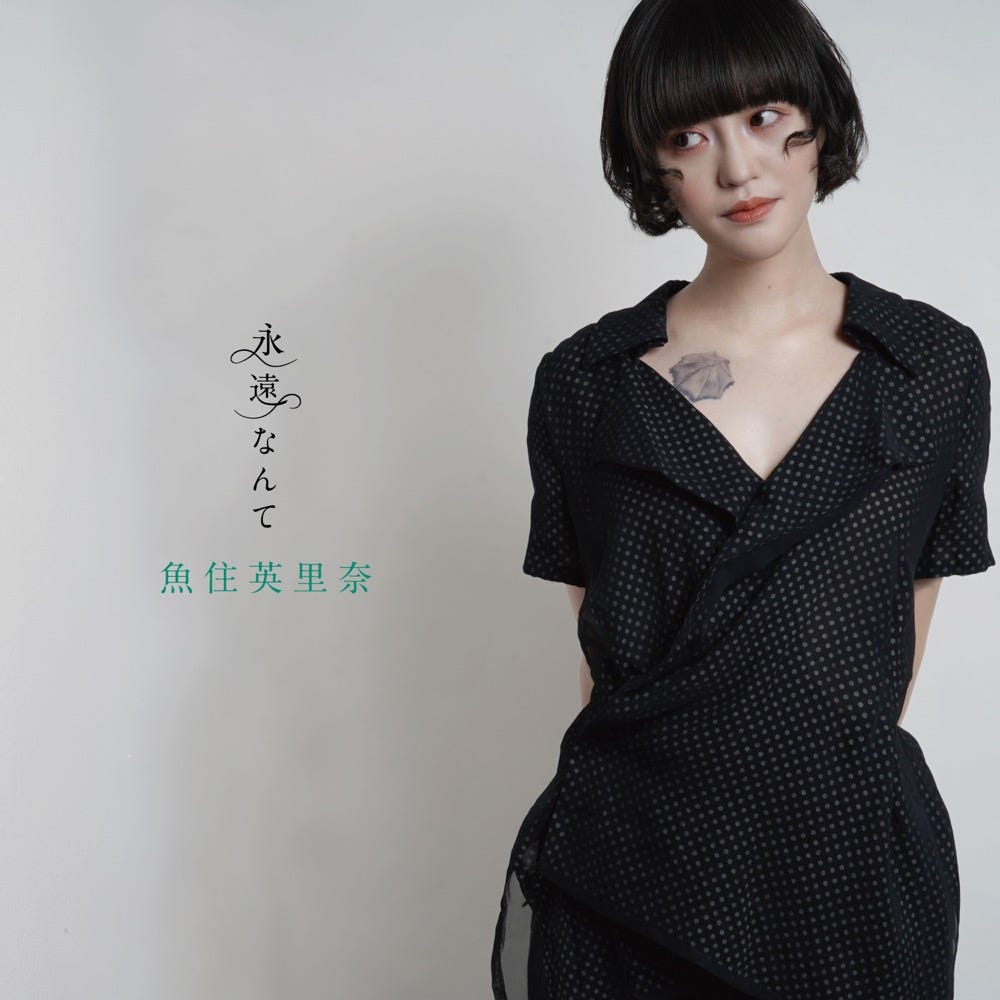
40:39 // March 25th, 2026 // 魚住造船
For all her fondness for the contradictory and carefully nurtured air of aloof cool, Erina Uozumi is among the most emotionally incisive folk artists of her generation, and her latest album Eien nante only cements her credentials. Alternating between gossamer reveries and lofi scrappers, this record thrives on songwriting decisions both over- and (more often) understated as it traces and retraces its series of slice-of-life snapshots.
Admittedly, her lyrical voice is elusive throughout the album, whether you’re puzzling over it from the other side of the language barrier or fixating on its many fragments and non-sequiturs outside of context. Uozumi is fond of dissolving the material framework of her scenes into queasy magical realism (Everyone’s a kid and you’re a mama too / Even the teacups can go flying in this house), yet her intimate arrangements – all her and her guitar, no conspicuous overdubs – demand that we locate the emotional centre of her delivery. How else do you listen to such fragile confessionals?
The unifying threads are there to see, chief among which is Uozumi’s deep ambivalence to commitment and attachment. This pervades the album even at its most opaque: we hear it most conspicuously in her relationship narratives, as she illustrates uneven compromises and egocentric cravings. Take the tongue-in-cheek selfishness with which she demands that her partner pay her more attention rather than go to work on “Watashi no tame ni shigoto yasume” (Take the Day Off for Me (track #3)), or the romantic idyll she finds in the opener, where she and her partner take it in turns to look the other way while they humour each other’s egos. She writes playfully on these tracks, but they introduce an interpersonal distance that later curdles into violence and scorn over “Amanita Pantherina” (track #7)’s ghoulish waltz time, and eventually congeals into mutually alienated tedium on the ferociously pithy closer.

This interrogation is uneasy and full of nuance: every time Uozumi laments the hopelessness of approaching romantic love as a basis for selfhood, she finds herself begrudgingly desiring it anyway — perhaps the perfect, perfecting soulmate is a myth for her, but that doesn’t make loneliness any less real. Unsurprisingly, her most complete statement on this topic is titled “Kekkon Shiyou” (Let’s Get Married (track #5)). This track is a longstanding feature of her setlist, and it parses out as follows:
生きることを馬鹿にしてないと死ぬことの方が正しく見えるし
生きる事に馬鹿に見えないと死ぬことの方が正しく見えるし

結婚しよう家族になろう
結婚しよう家族になろうよ

抱きしめて側にいて自分のことが分からないの
抱きしめて側にいて簡単な心で家族になろうよ

生きることを馬鹿にしてないと死ぬことの方が正しく見えるし
生きる事に馬鹿に見えないと死ぬことの方が正しく見えるし

結婚しよう家族になろう
結婚しよう家族になろうよ

抱きしめて側にいて自分のことが分からないの
抱きしめて側にいて簡単な心で家族になろうよ

結婚使用 家族になろうよ 結婚しよう
家族になろうよ 結婚しよう 家族になろうよ 結婚しよう

誰かと居ても孤独だよ
誰かと居ても孤独だよ
誰かと居ても孤独だよ
誰かと居ても

抱きしめて
抱きしめて
抱きしめて

家族になろうよ

生きることを馬鹿にしてないと死ぬことの方が正しく見えるし
生きる事に馬鹿に見えないと死ぬことの方が正しく見えるし

If I don’t make a joke out of life
then dying looks like the right thing to do
If I don’t seem a fool in life
then dying looks like the right thing to do

Let’s get married
Let’s be a family
Let’s get married
Let’s be a family!

Hold me
Stand by me
I don’t understand myself
Hold me
Stand by me
Let’s be a family
With simple hearts

Being with someone
is still so lonely

[repeats preserved in the Japanese but omitted in the English]
While this is by far the album’s most lyrically contingent offering (good luck navigating its nervous acoustic syncopations otherwise), it’s highly characteristic of Uozumi’s voice and style. She uses simple language to touch on complex fault lines, and there’s an intimately human shape to her contradictory utterances and abrupt changes of perspective — the song’s opening lines don’t so much ‘make sense’ as they illustrate the insecurities and warped logic that do inform many people’s life-defining commitments. She maintains a certain aloofness, per the ironic distance with which she romanticises naivety (Let’s be a family / With simple hearts) and self-erasure (I don’t understand myself / Hold me), but she never sounds anything less than sincere. Her interplay between perspectives reflects the doubts, confusions and insights that churn together within the same mind, and it speaks to her strength as a songwriter that she trusts her audience to trace a deeper narrative as she flits from one to another.
On “Kekkon Shiyou” and elsewhere, she gives us more than enough to intuit the gist, however opaque her phrasing. Even on my first listen, I was practically waiting for her to deliver the song’s defining couplet by the time she reached it (Being with someone / Is still so lonely); the truth of those lines is all the more resonant for how she folds us into the thought process it takes to get there.
This is hardly the only device through which Uozumi achieves psychological unity within her work. Her metaphors tend to rub against her aesthetics, and so Eien nante is full of the sky, both lyrically and otherwise. Uozumi makes such extensive use of reverb that it’s practically a third party to the otherwise uncompromised pairing of her and her guitar (see the gloriously gauzy midsection of “Amanita Pantherina”), while her lyrics see her forever raising her gaze to the heavens as though to diffuse her material dissatisfaction and fleeting emotional impulses across their expanse. This is far from mere escapism: her brief moments of flight are unnerving, gravity-bound and heavily gendered in “Norlevo” (track #4, named after the Japanese morning-after pill), while the opener’s title-lyric – entrusting my body to the winds of indifference – is a giddy acknowledgement that the forces governing her are entirely impassive. The sky is a consistent metaphor for her yearning for the formless, the transitory, the space to treasure the ephemeral and to accept emotions as inherently mutable rather than allow them to impose a fixed sense of self.
It chimes with this that Uozumi places great importance on the inconsistent and the trivial, as on the stunning “Boku wa gyoza wo yaku BOY” (track #6), a track so beautiful you worry it would disintegrate if she raised her voice above a whisper. The chorus line delivers the clearest digest of the sharp-edged wabi sabi spirit that pervades the whole album (The plums are in bloom / and I can’t stand fate at all), and the rest of the song is one tribute after another to the joy of passing irregularities: she gets lost on her usual route through town, pushes back her dinnertime, messes up her recipe, and, of course, slips out of herself and into the eponymous persona: a boy frying gyoza.
And why not take comfort in inconstancy? It’s emotional prescriptivism that provides the most concern here! On her feistiest number, “Ballad” (track #8), Uozumi recites a diatribe against the titular song style and its tendency towards calcified sentimentalism, strumming moodily as she alternates between direct critique and barbed satire of the target audience (which, for her, is a zombie hooked to the saccharine promise of frictionless pish). I’m longing for the moment I’m not myself anymore / Someone else will take care of it, she growls, as much to us in warning as to herself in admonition.
She goes further still on the flatly devastating “Shūden” (Last Train, track #9), where she confronts herself as a shell of a person too fatigued by commitment to lead a meaningful life and joylessly preoccupied with petty banalities. In the album’s most disarming twist, Uozumi lays the blame for the narrator’s decline not on weakness of character or an interfering third party, but on a vapid ideal of happiness that led her to lose sight of herself:
大体のことは自分の心を掻きむしるから
面倒になった約束は二度としないわ
最低と言ってくれそうだったあの人は簡単に幸せと言ってしまうようになった

簡単に幸せにするなよ
簡単に幸せになるなよ
簡単に幸せにするなよ
簡単に幸せになるなよ

Things on the whole claw at my heart
My promises burden me, so I won’t make them again
She was the type to have said “that’s the worst”
But now she’d just say “I’m happy”

Don’t ‘just’ bring happiness
Don’t ‘just’ be happy
Don’t ‘just’ bring happiness
Don’t ‘just’ be happy
Her delivery of those central lines is profoundly affecting in its strain and frayed edges, and it offers a visceral centre of catharsis that the other songs shy away from. Even then, it’s far from relieving — how could it be? It’s the penultimate track of an album where she has done nothing if not refute the prospect of an easy way out to complex emotional binds, where she has expertly mapped out the pitfalls of stale routines and strained co-dependency, yet still can’t bring herself to abandon the allure of everyday contentment entirely. No one who’s made it this far will be holding out for a convenient burst of closure.
“Shūden” aside, Eien nante’s aversion to climactic flashpoints sets it firmly apart from Uozumi’s last record ISO1600 no hanayome (2021), which distinguished itself with adventurous song structures and a fondness for tearaway cathartic bridges. Eien nante is arguably the more refined of the two, but the centre of this refinement lies in the mutually enriching link between Uozumi’s lyrics and delivery, in how her personality shines through the frosted-glass gloom of her subject matter and offers a glimpse of something so tenaciously personable that, by sheer virtue of its presence, it momentarily redeems the same purgatorial Everyday it stews within.

How does one get a handle on all this as a non-Japanophone? These are good folk songs on anyone’s terms and the gist is sometimes graspable from performance alone, but I cannot imagine engaging nearly as intently with, say, “Norlevo” minus its contraceptive subtext, or “Watashi no tame ni shigoto yasume” minus its biting undertone of self-reproach. Perhaps I’m overstating this hurdle having been drawn to the lyrics from my first listen (and having pored over the booklet since), but it’s a real shame if not: Eien nante is a flooringly coherent snapshot of all-too-familiar existential uncertainties, and it speaks its truths too powerfully to be gatekept by language.
8.5/10
Further listening:
Erina Uozumi - ISO1600 no hanayome
Oomori Seiko - Zettai Kanojo
Renge - Lights
Saya Gray - 19 MASTERS
Neko Case - Middle Cyclone