


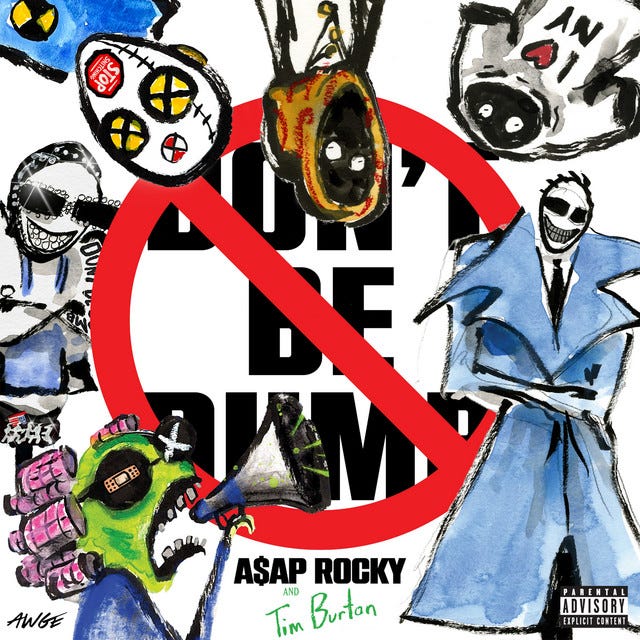
59:49 // January 16th, 2026 // RCA
After breaking away from the crowded ambitions of A$AP Mob, Rocky wasted very little time staking his claim as a solo artist. Judged purely on technical ability, his efforts have remained impressively consistent, albeit frequently unremarkable, with many of his most celebrated tracks coasting by on mood, texture and atmosphere rather than lyrical distinction. Yet this framing ignores Rocky’s true defining strength: his curatorial ear. His unwavering commitment to persistently interesting, atypical production — unconventional without ever completely severing ties to hip hop sensibility — has been borderline faultless. With the rise to popularity from his debut mixtape, he brought his lush, ambient brand of cloud rap to the mainstream crowd. Its reliance on spacey, almost distant production is what defined his early work, relying heavily on the effect of the mix and beats more than anything else, and it absolutely worked. His second full-length, AT.LONG.LAST.A$AP, marked the occasion where both aspects began to fully cohere, pairing grit with a psychedelia that bent Rocky’s rapping contribution to the outermost contours of his instrumental selections, resulting in his most complete artistic statement to date.
Testing, though an admirably audacious switch-up, struggled to replicate that balance, seemingly hit by the same creative lethargy that plagued ScHoolBoy Q’s CrasH TalK, which dropped the following year. The experimentation felt restless rather than refined, ambitious but scattered; more enamoured with the idea of disruption than the discipline required to convincingly shape it. Don’t Be Dumb corrects that imbalance with the verve of an accomplished auteur who understands that not every idea needs to make it into the final cut. Its renewed commitment to experimentation is not only its greatest asset, but also the mechanism through which Rocky finally unifies his artistic strengths, leveraging restraint, selection and atmosphere to transform limitation into intention.
Now, perhaps the greatest concern with Don’t Be Dumb is if it was worth the wait. Eight years separate this and Testing — an absurd gap considering the rest of his solo efforts were released within a seven year span. The answer is more complicated than a yes or no, unfortunately. If you’re expecting a return to the southern fried, cloud rap dominance of LIVE.LOVE.A$AP or LONG.LIVE.A$AP, then you will be sorely disappointed. On the other hand, if you expect a Testing 2.0 with a heavier dip into the trap style of hits like “Praise the Lord (Da Shine)’’, you also won’t necessarily find that here. Don’t Be Dumb instead toes the line between, incorporating elements found throughout his career with a modern twist. For example, the introduction of “No Trespassing” leans into the heavy atmospherics of the cloud rap style before bursting into a chaotic mix of 808s and subdued synth samples of a catchy trap rhythm. It can’t be placed into one era of Rocky, but rather, it condenses all his years of experience and expertise and combines them into a cohesive piece. This is what ultimately defines Don’t Be Dumb: the former eras refracting into a modern identity; Rocky hasn’t lost his step but has created a new path.
Don’t Be Dumb follows the same confident strut of recent left-field hip hop releases like Starburst and Don’t Tap The Glass, sculpting a sound that enthusiastically colours outside the lines without forgetting to stay stylistically legible. The experimentation skews both elaborate and minimal, brash and thoughtful in equal measure, with liberal dashes of punk and trap aesthetics thrown in to taste. Despite its maximalist tendencies, it’s always deliberate and highly orchestrated; immersive without feeling overindulgent, occasionally overpowering but never oversaturated. Where his early mixtape and records relied heavily on creating space and expounding breathing room, Don’t Be Dumb excels in filling that ‘void’ with high energy beats and added production elements that make the tracks feel borderline overstimulating at times. Despite this, nothing attempts to forcefully strongarm the listener, with Rocky opting for a steady-handed boldness over cheap provocation, and the atmosphere is all the better for it. His subtle, slightly lower spot in the mix on the more energetic tracks positions him as part of the terrain rather than the guide; less centre stage, more moving piece of the musical environment.
This approach is apparent from the outset, with ‘‘Order of Protection’’ piquing interest through twinkling keys before pulling the rug into bassy urgency, its menacing tone pumiced by firearm sound effects and an echoing vocal that transforms the hook into a clattering earworm. Follow-up ‘‘Helicopter’’ pushes this further as the record’s first white-knuckle heater, weaving glossy ’80s accents into a modern, trap-inflected framework where Rocky sits low, yet integral, within the mix. Rather than wrestling for dominance, he lets the skittering momentum lead, and his presence becomes a load-bearing rafter of the track’s architecture instead of floating overhead.
If the gritty but colourful production supplies the infrastructure, the lyrical content would undoubtedly function as the interior design: sparse, loaded with asides and far more concerned with register than proclamation. Though rarely reaching for thematic statements that could be considered ‘grand’, he nonetheless incorporates flex, severity and a considered sardonic detachment to sell the album’s ideas of evolution, both artistic and personal. The rough-and-tumble composure that these are delivered with deftly mirrors the measure of the record’s disciplined sprawl, with the imposing, static-spiked synths and resonant chimes of ‘‘Stole Ya Flow’’ exemplifying an attitude of stake-in-the-ground audacity: provocative, but not without just cause (cough cough). The grimacing momentum, reinforced by the piano-led decompression and declaration of with all due respect, I hope you take offence…, displays how Don’t Be Dumb weaponises atmosphere, not over narrative, but as narrative.
‘‘Stop Snitching’’, meanwhile, keeps its urgency nasty and straightforward, with pitchy horn samples and warping backspins framing an imperative yet unusually elegant flow. In such moments, Rocky isn’t chasing virtuosity so much as establishing (and reinforcing) presence, and in doing so transforms his long-standing reliance on mood into a coherent philosophy, where restraint, menace, humour and energy become the foremost aspects. Elsewhere, the record offers breezier moods by loosening its grip a fraction, with ‘‘Stay Here For Life’’ riding a classic hip-hop gait through sun-kissed textures and early-era Rocky cadences, recalling a ‘‘Purple Swag’’-esque nonchalance. All this before he pulls the plug and leads into a slickly-judged beatswitch that allows a hazier afterimage to unfurl like a lion stretching out in warm sunbeams.
Don’t Be Dumb was always bound to be divisive. With such a large gap between releases, there are sure to be lofty expectations: return to form, continuing the evolution of Testing, experimenting with something new… the list goes on. However, no matter what side of Rocky you land on, there is a lot to like on Don’t Be Dumb. It won’t appeal to everyone, but there is so much intentionality within the record that everyone can appreciate at least one point. Whether it’s the glitchy “Air Force (Black DeMarco)’’, the brooding “Whiskey (Release Me)” with the classic bo-bo-bo-bo-bo-bo-bo-bo-bo-bo-boooooom ad libs of Westside Gunn contrasted by Damon Albarn’s subtle Gorillaz vocals, or the beautifully atmospheric highlight “Don’t Be Dumb / Trip Baby’’, Rocky has clearly poured out his musical heart into this project in a massively successful way. It cross-laces an ethos of restraint over excess, intention over novelty and, most importantly, curation as a form of authorship. Returning to the ScHoolboy Q comparison; if Testing was Rocky’s CrasH TalK, then Don’t Be Dumb is undoubtedly his Blue Lips moment.
8.5/10